Shopping for a titanium pan can get confusing fast. One listing says
pure titanium. Another says solid titanium.
A third highlights a titanium coating. The names sound similar, but they may
describe very different products.If you’re comparing pure titanium vs titanium coated cookware,
start with two questions:
What touches your food, and what is the rest of the product made from?
Those answers tell you more than the word “titanium” on its own.
Pure Titanium vs Titanium Coated: The Quick Difference
These terms describe different things, so they are not always competing labels.
A product can use titanium as its main body material, as a food-contact surface,
or as part of a coating or surface treatment.
Label
What It Describes
What to Check
Pure titanium
The titanium material used in a specified part of the product.
Does it describe the whole body, the interior, the cooking surface, or one component?
Solid titanium
Titanium through the thickness of the specified body or part rather than a surface coating.
What material specification is used, and which other components use different materials?
Pure titanium cooking surface
The titanium material directly beneath the food.
What other metals or layers form the rest of the cookware body?
Titanium-coated or titanium-reinforced
A coating or surface treatment that incorporates titanium in some form.
What is the surface system, and what material is underneath it?
What Does “Pure Titanium” Mean?
In material specifications, pure titanium generally refers to
commercially pure titanium. Commercially pure grades are distinct
from titanium alloys formulated with larger additions of other elements.For shoppers, however, the next question is more practical:
where is that titanium actually used?A pure titanium cutting board may have a board body made from titanium.
A pan may use pure titanium at the cooking surface while other metals form
part of the structure underneath it.Both products may accurately use the word “titanium,” but they do not have
the same construction.“Pure” describes the specified material. It does not automatically tell you
the thickness, number of layers, handle material, lid construction, or the
composition of every other component.
Is Solid Titanium the Same as Pure Titanium?
Not necessarily.
Solid describes construction; pure describes material composition.A solid titanium part has titanium through its thickness rather than
a titanium-containing surface coating applied over another material.But “solid titanium” does not mean that every component of an assembled
product must also be titanium.A bottle may have a titanium body with a separate seal.
A pan may use a different handle material.
A cup may use a lid made from another material.For a pure titanium cutting board, look for a specification that identifies the material used in the board itself.
A silver color or metallic finish alone is not enough to establish composition.
What Does Titanium-Coated Cookware Mean?
Titanium-coated is a broad product term.
It generally describes a surface coating or treatment used over another material.The underlying cookware body may be aluminum, stainless steel, or another metal.
That is different from cookware where titanium itself forms the food-contact
metal surface.Some cookware uses coating systems reinforced with titanium-containing material.
Other titanium-related surface technologies may use different compositions
and manufacturing methods.That means the word “titanium” alone does not tell you whether the cooking surface
is titanium metal, a titanium-containing coating, or another type of surface treatment.Before buying, look for:
The base material
The food-contact material
The coating or surface description
Care instructions
Utensil recommendations
What Matters Most: The Food-Contact Surface
For cookware, one of the most useful questions is simple:
What material is directly beneath the food?
Two pans can both contain titanium while having completely different
food-contact surfaces.One may use titanium metal at the cooking surface.
Another may use a titanium-containing coating over a different base material.That distinction is usually more useful than a large “TITANIUM” label
on the front of a package.
Can a Composite Pan Have a Pure Titanium Cooking Surface?
Yes. A composite pan can combine a pure titanium food-contact surface
with other metals in the cookware body.Different layers can perform different jobs. The cooking surface can provide
the food-contact material, while the layers underneath can contribute heat
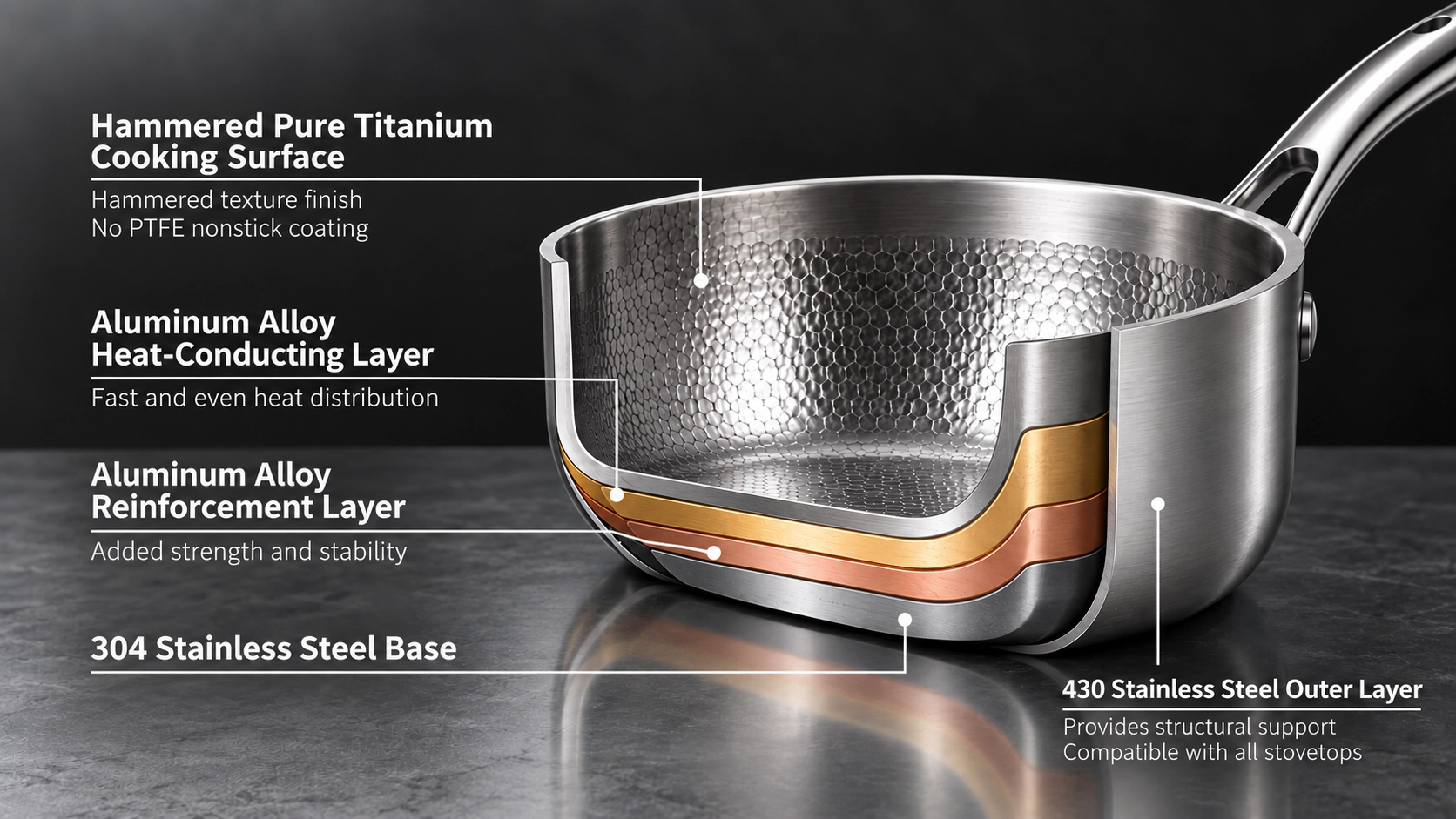
distribution, structural support, and cooktop compatibility.TiRoam’s titanium frying pan with a pure titanium cooking surface is one example of this type of construction.Its five-layer construction uses a
hammered pure titanium cooking surface,
two aluminum-alloy layers, a 304 stainless steel base,
and a 430 stainless steel outer layer.Here, pure titanium describes the cooking surface, not the entire pan body.
That distinction is important when comparing composite cookware with products made
from a single titanium body.Five-layer TiRoam cookware construction: hammered pure titanium cooking surface, two aluminum-alloy layers, 304 stainless steel base, and 430 stainless steel outer layer.
How the Five Layers Work Together
1. Hammered Pure Titanium Cooking Surface
The food-contact surface is pure titanium with a hammered texture finish.
It is an uncoated metal cooking surface rather than a PTFE nonstick coating.
2. Aluminum Alloy Heat-Conducting Layer
An aluminum-alloy layer sits beneath the titanium cooking surface
to help distribute heat across the cookware body.
3. Aluminum Alloy Reinforcement Layer
A second aluminum-alloy layer adds structural support to the composite construction.
4. 304 Stainless Steel Base
The 304 stainless steel layer contributes strength and durability
within the cookware body.
5. 430 Stainless Steel Outer Layer
The outer 430 stainless steel layer provides additional structural support
and forms part of the exterior cookware construction.The important point is that these materials work together as one composite body.
The cooking surface is titanium, while the supporting layers underneath use
different metals for different functions.
Why Do Cookware Brands Use Different Constructions?
There is no single construction that makes sense for every product.A lightweight camping pot has different requirements from a frying pan designed
for everyday kitchen use. A cutting board has different requirements from both.Cookware design can involve several factors, including:
Food-contact material
Heat distribution
Weight
Shape and thickness
Handle construction
Cooktop compatibility
Cleaning and care
That is why shoppers may encounter solid titanium products,
single-wall titanium cookware, multilayer cookware with a titanium cooking surface,
and titanium-coated products.The material name alone does not establish how a product is constructed.
The full specification matters.
How to Read a Titanium Cookware Listing Before You Buy
1. Identify the Food-Contact Surface
Look for a clear statement explaining what material actually touches the food.Specific language such as
pure titanium cooking surface
is more useful than broad phrases such as
titanium technology.
2. Check the Full Construction
Determine whether the product uses:
A single-material body
A multilayer or composite body
A surface coating over another metal
Also check the specifications for handles, lids, seals, and bases.
3. Separate the Surface Material From the Pan Body
A pan can use one material where food touches the surface and different
materials elsewhere in the cookware body.This is normal in composite cookware.
4. Read the Cooking and Care Instructions
Do not assume that the word “titanium” means naturally nonstick,
compatible with every stove, or suitable for every cleaning method.Follow the instructions for the exact product.
5. Look for Specific Information Behind the Label
A useful product page should explain the material and construction in plain language.Material specifications, construction diagrams, care instructions,
and applicable testing provide more useful information than vague claims such as
“premium titanium” or “advanced titanium technology.”
What About Titanium Alloys?
You may also see the term titanium alloy.A titanium alloy combines titanium with other elements to produce particular
mechanical properties. That is different from commercially pure titanium,
and it is also different from titanium-coated cookware.For most shoppers, there is no need to memorize every titanium grade.
Start with three basic questions:
What is the main material?
What material touches the food?
How is the product constructed?
Those three answers usually tell you far more than the word “titanium” alone.
A Simple Rule to Remember
If a product says titanium, do not stop there.
Is titanium the product body, the food-contact surface, or part of a coating system?
That one question makes it much easier to compare
pure titanium vs. titanium-coated cookware
without getting lost in marketing language.At TiRoam, material descriptions are intended to identify where titanium
is actually used. When a product uses a composite or multilayer construction,
that construction should be described separately rather than implying that the
entire product is solid titanium.Different products need different designs.
What matters is knowing what you are buying.
Frequently Asked Questions
Is pure titanium the same as titanium-coated?
No. Pure titanium describes the titanium material itself in the specified
part of a product. Titanium-coated products use another base material
with a coating or surface treatment that incorporates titanium.
Can cookware have a pure titanium surface without being solid titanium?
Yes. A multilayer or composite pan can use a pure titanium cooking surface
while other metal layers form the rest of the pan body.
Does “solid titanium” mean every part of the product is titanium?
No. Solid titanium can describe the main body or a specific component.
Handles, lids, seals, and other parts may use different materials.
What should I check before buying titanium cookware?
Check the food-contact surface, overall construction, material specifications,
care instructions, cooktop compatibility, and any applicable documentation
provided by the manufacturer.
Explore Related TiRoam Products
TiRoam creates pure titanium cookware, tableware, drinkware, travel gear,
and outdoor gear for practical everyday use.