
Cookware & Food Prep
Do Titanium Cutting Boards Dull Knives? What to Know Before Buying
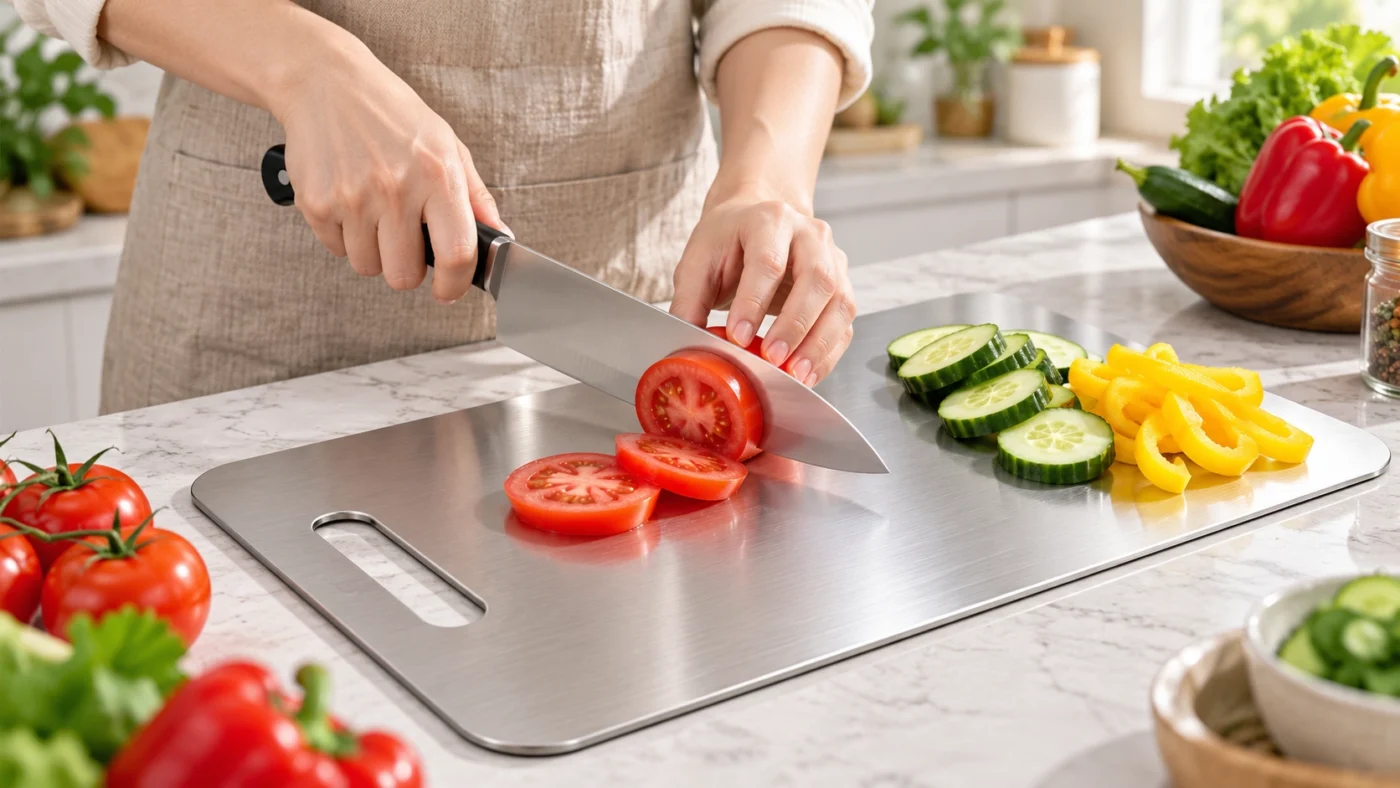
A titanium cutting board may appeal to you because of its simple metal surface and straightforward care. But before buying one, it is worth asking what that surface means for your knives.
Titanium cutting boards can contribute to knife-edge wear. Published comparative testing has also found greater loss of sharpness on a titanium board than on the wood and plastic boards included in the same comparison.
That does not mean every titanium board will dull every knife at the same rate. A test involving particular boards and knives cannot tell you exactly how often your own knife will need sharpening.
The practical question is whether titanium’s material and maintenance characteristics suit your kitchen well enough to accept the possibility of additional knife maintenance.
For most buyers, that is the real tradeoff.
What Comparative Testing Has Found
A comparative product test published by Prudent Reviews used a BESS sharpness tester to compare several cutting-board materials.
A BESS tester measures the force required for a blade to cut a standardized test medium. A higher reading indicates a less sharp edge.
The test included 300 rocking cuts and 300 straight chops before the knives were measured again.
In that comparison, the titanium board produced greater loss of sharpness than the wood and plastic boards tested. A follow-up comparison using two knives of the same model also showed greater dulling on titanium than on an end-grain walnut board.
Under the conditions tested, the titanium board produced a greater measured loss of sharpness than the wood and plastic boards included in the comparison.
That result matters, but so do the limits of the test.
The boards, knives, cutting motions, and number of repetitions were specific to that comparison. Starting sharpness was not identical in every group, so the results should not be turned into a universal claim about exactly how much faster every knife will dull on titanium.
There is also an arithmetic inconsistency in one of the published titanium results. The listed starting value of 345 and final value of 739 produce a difference of 394, while the table reports 444.
That does not erase the overall direction of the test. It does mean the results should be treated as comparative evidence rather than a precise formula for predicting sharpening frequency.
You can review the original comparative test and results if you want to see the procedure and measurements in detail.
Why “Titanium Is Softer Than Knife Steel” Does Not Answer the Question
A common argument is that titanium cannot dull a knife because the board material is softer than hardened knife steel.
That comparison is too simple.
A knife edge is extremely thin. Repeated contact with a cutting surface can change how that edge performs even when the surface itself is softer than the blade as a whole.
Knife-edge retention can be influenced by the cutting surface, blade steel, edge geometry, sharpening angle, cutting pressure, cutting motion, and repeated contact during food preparation.
The same problem applies to another common argument: if the titanium board develops scratches, the knife must be unharmed.
A scratched board only tells you that the board surface has changed. It does not establish that the knife edge remained unchanged.
This is why terms such as knife-friendly should be treated carefully.
If a cutting-board manufacturer wants to claim that a surface performs as gently as wood, the most useful evidence would be controlled before-and-after testing using clearly identified knives, boards, cutting motions, and measurements.
A material certificate can tell you what the board is made from. It cannot, by itself, establish how well a knife will retain its sharpness on that surface.
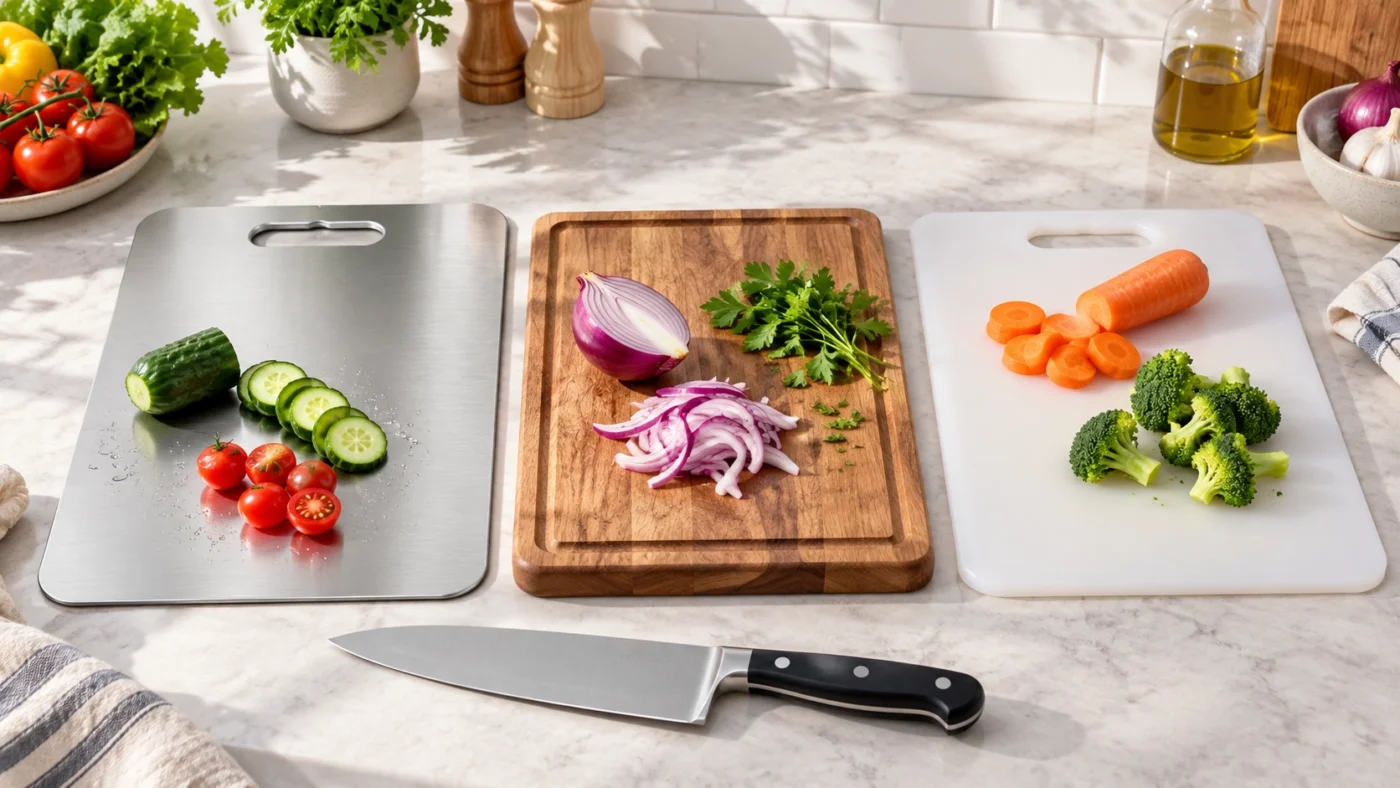
Titanium, Wood, and Plastic Solve Different Problems
There is no cutting-board material that wins every comparison.
Suitable wooden boards are often chosen because the cutting surface provides some give under the knife. That can be useful when preserving a fine edge is a priority.
Wood also has its own care requirements. Depending on the board, that may include thorough drying and occasional oiling or conditioning.
A suitable wooden board can therefore offer a forgiving cutting surface while requiring a little more attention to board care.
Plastic and synthetic boards solve different problems. Some provide a relatively forgiving cutting surface, but repeated use can leave grooves and visible wear. Different plastics also vary in hardness and construction, so they should not all be treated as one material.
Titanium takes a different approach.
A solid titanium cutting surface may appeal to someone who wants to avoid a plastic cutting layer or the conditioning routine associated with many wooden boards. Titanium also does not swell from normal exposure to water in the way wood can.
Those are useful material characteristics.
They are not evidence that titanium preserves a knife edge as well as a suitable wooden or softer synthetic cutting surface.
That distinction is important because board maintenance and knife maintenance are separate questions.
A board can simplify one routine while increasing the importance of the other.
What This Means for Everyday Cooking
There is no dependable rule for how often a knife used on titanium will need sharpening.
Someone who cooks several times a day with a thin, finely sharpened knife may have a very different experience from someone using a heavier general-purpose knife a few times a week.
The practical expectation is simply this:
If you choose titanium, your knife may need attention sooner than it would on an appropriate softer cutting surface.
How much sooner cannot be predicted from board material alone.
A loss of sharpness also does not tell you, by itself, whether the edge needs honing, sharpening, or repair. Those are different forms of maintenance.
Follow the care guidance for your particular knife rather than assuming every change in cutting performance can be corrected through routine honing.
If the maker of your knife advises against metal cutting surfaces, that recommendation should be taken seriously.
This is especially worth checking for thin or finely sharpened edges.
Using a Titanium Cutting Board in Your Kitchen
Choosing titanium does not require pretending the knife-care tradeoff does not exist.
It simply means deciding whether its other characteristics matter enough to you.
Some people prefer a solid metal preparation surface. Others want to avoid a plastic cutting layer. Some may also prefer not to oil or condition a wooden board.
Those are reasonable preferences.
If you decide to use a titanium cutting board, use it with the same attention you would give any other part of your kitchen setup.
Keep the board stable while cutting. Avoid unnecessary force. When moving chopped ingredients, use a scraper rather than repeatedly dragging the sharpened edge of the knife sideways across the board.
Pay attention to changes in cutting performance and maintain the knife according to its own care instructions.
There is also no rule saying that one cutting board has to handle every knife and every task in your kitchen.
You may prefer to keep a softer cutting surface for a thin or finely sharpened knife while using titanium for other preparation tasks.
Heavy chopping, bones, and frozen foods are another matter. Those jobs are better handled with knives and cutting surfaces intended for that kind of work.
Is a Titanium Cutting Board Right for Your Kitchen?
The answer depends on what matters most to you.
If preserving a fine knife edge for as long as possible is your leading priority, the comparative evidence gives you a reason to consider an appropriate softer cutting surface.
If you value titanium because of its material, simple care routine, and absence of a plastic cutting layer, you may decide that the possibility of additional knife maintenance is an acceptable tradeoff.
The important point is to know that the tradeoff exists.
A durable cutting board does not automatically mean less wear on your knife. Board durability and knife-edge retention are different kinds of performance.
When comparing TiRoam titanium cutting boards with wood, plastic, or other alternatives, consider both sides of the decision: what the particular board offers and what the knives you already use require.
That is more useful than expecting one cutting-board material to be perfect for every kitchen.
Frequently Asked Questions
Will a titanium cutting board dull my knife faster than wood?
In the comparative test discussed above, the titanium board produced greater sharpness loss than the wooden boards tested.
That supports caution, but it does not establish the exact difference for every board and knife combination.
Does pure titanium mean a cutting board will not dull a knife?
No.
Material composition alone does not establish knife-edge performance. A board being made from pure titanium does not prove that it will preserve a knife edge as well as wood or another softer cutting surface.
Does a smooth or textured titanium surface prevent dulling?
The surface description alone cannot establish that.
Terms such as smooth, brushed, or micro-textured describe the surface finish. They do not prove a particular level of knife-edge retention without relevant comparative testing.
How often will I need to sharpen my knife on titanium?
There is no dependable schedule based only on cutting-board material.
Your knife, edge geometry, frequency of use, cutting technique, and maintenance routine all affect how often the edge will need attention.
Can I use titanium for some tasks and another board for others?
Yes.
You do not need to use the same cutting surface for every knife or every food-preparation task. Using different boards for different knives may be more practical than expecting one material to meet every requirement.