
Drinkware & Everyday Carry
Titanium Cups, Mugs, and Tumblers: Which Fits Your Daily Routine?
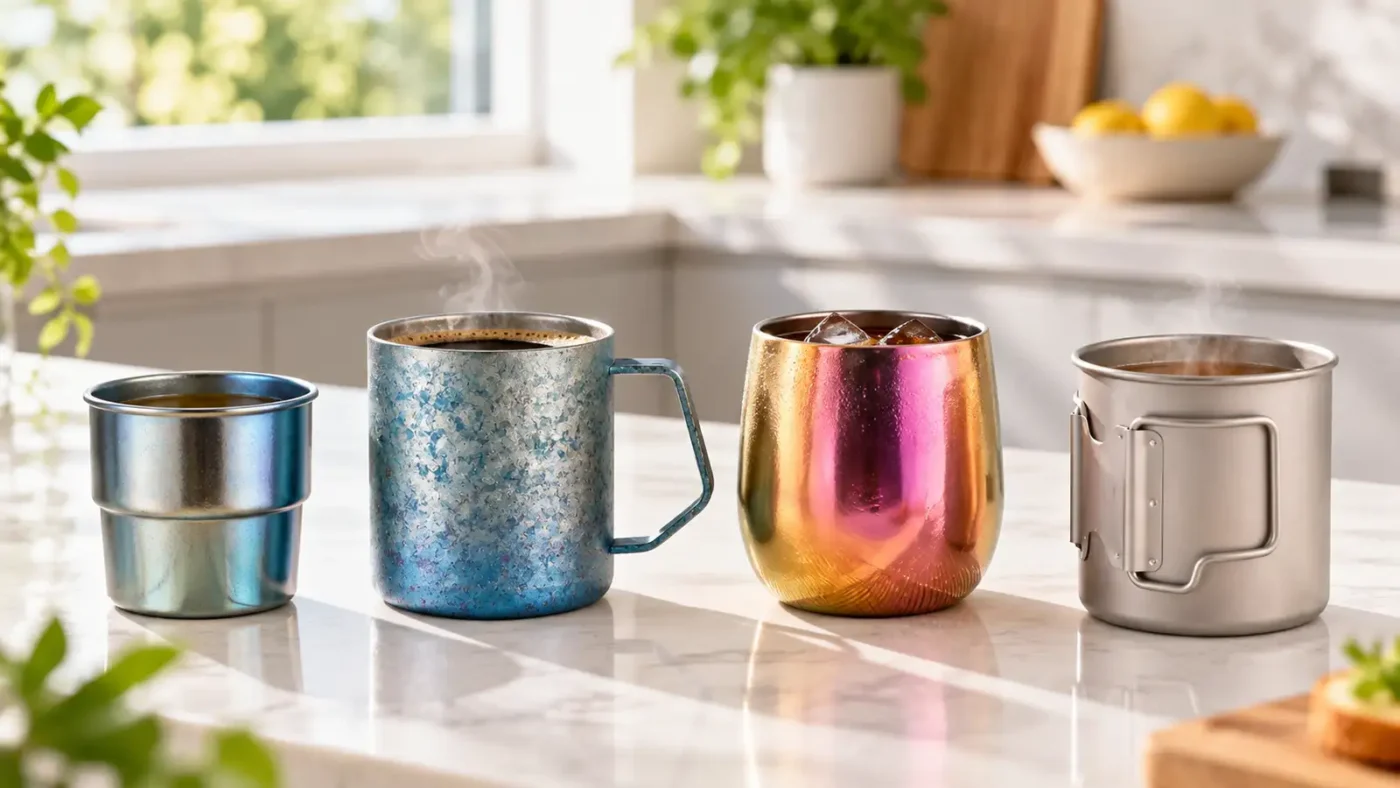
In a titanium cup vs mug vs tumbler comparison, choose a cup when compact storage and simple handling matter most, a mug when you prefer a dedicated handle, or a tumbler when you want a handle-free shape for water, coffee, tea, or cold drinks. The names overlap across brands, so compare the actual handle, capacity, wall construction, opening, and dimensions instead of relying on the product label alone.
What Is the Difference Between a Cup, Mug, and Tumbler?
The most useful difference is the complete product design: a cup is a broad category, a mug normally emphasizes a handle, and a tumbler is commonly handle-free. These terms are not strict technical standards, however, and manufacturers may use them differently.
For TiRoam’s current drinkware, the formats can be separated this way:
| Drinkware type | Current TiRoam design | Best reason to consider it |
|---|---|---|
| Stackable cup | Handle-free, stackable pure titanium cup | Compact cabinet or travel storage |
| Coffee mug | Fixed handle with double-wall vacuum construction | Familiar desk and table handling |
| Tumbler | Rounded, handle-free, double-wall design | Simple in-hand use for hot or cold drinks |
| Folding-handle mug | Pure titanium body with handles that fold against the cup | Reduced handle bulk when packed |
The labels provide a starting point, but they do not answer every buying question. Capacity, wall construction, included parts, and care requirements still need to be checked on the exact product page.
Choose a Titanium Cup for Compact Storage
Choose a titanium cup when you want a simple drinking vessel that stores efficiently and does not need a fixed handle. It can work at the kitchen table, beside a work setup, or inside a travel bag.
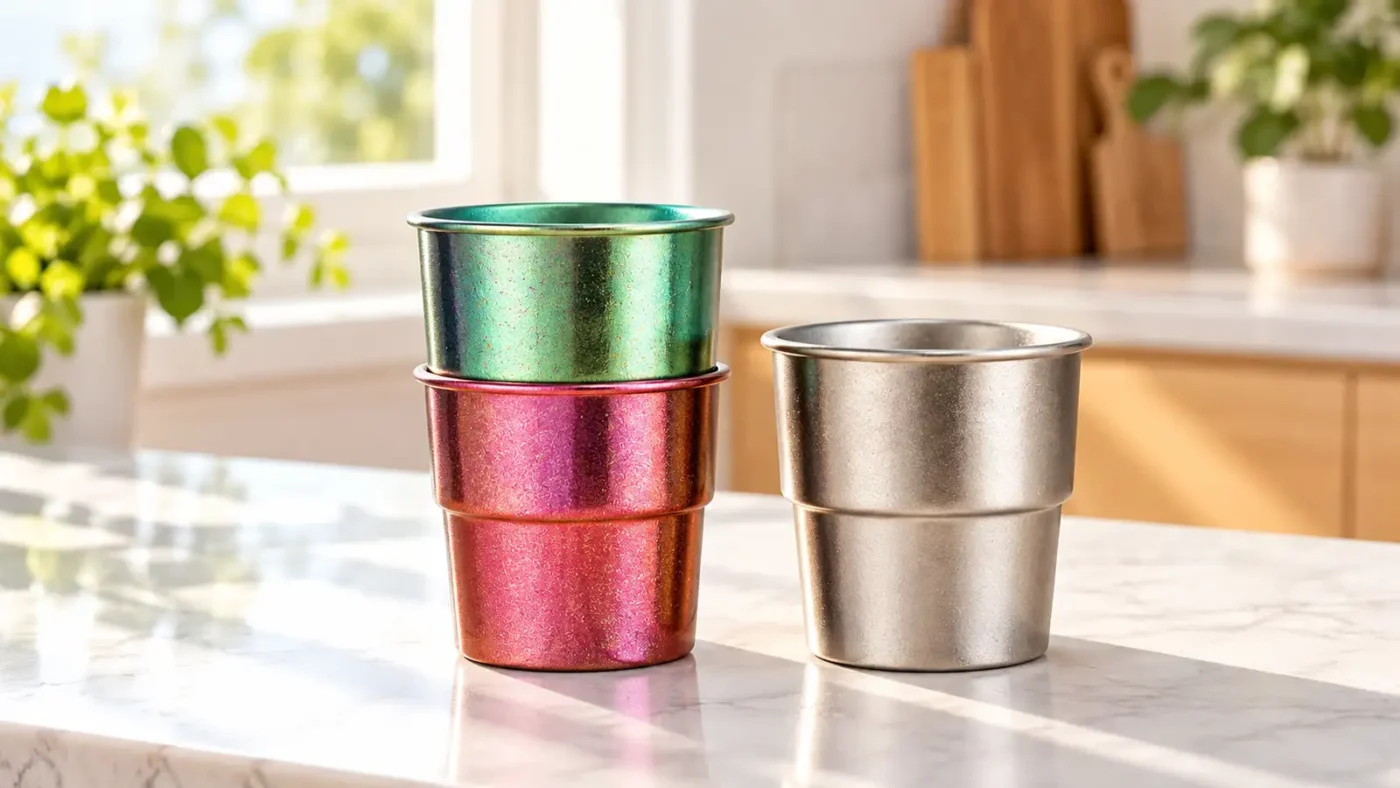
The current Stackable Pure Titanium Cup has a handle-free, stackable design. Its listed capacity is 330 ml / 11.1 fl oz, with a top diameter of 8.3 cm / 3.3 in, a bottom diameter of 6.5 cm / 2.6 in, and a height of 9 cm / 3.5 in. The listed weight is 45 g / 1.6 oz.
The stackable shape is the main practical distinction. Multiple cups can occupy less cabinet space than fixed-handle mugs, provided the products are specifically designed to stack. That can be useful in a smaller kitchen or when several matching cups need to be stored together.
A handle-free cup does require you to hold the body directly.
Choose this format when:
- Compact storage is a priority
- You prefer a simple handle-free shape
- You expect to store or carry more than one cup
Choose a Titanium Mug When a Handle Matters
Choose a titanium mug when you prefer lifting and repositioning a drink by a handle. This is often useful for coffee or tea at a desk, dining table, or kitchen counter.

TiRoam’s current Pure Titanium Coffee Mug has a fixed handle and a listed capacity of 430 ml / 14.5 fl oz. The product page identifies it as having double-wall vacuum construction. Its listed dimensions are 10.5 cm / 4.13 in high, with an 8.4 cm / 3.31 in mouth diameter and a total width of 12.5 cm / 4.92 in including the handle.
The handle changes more than the way the mug looks. It also affects:
- The total width needed on a shelf
- How the mug fits beside a keyboard or notebook
- How easily it can be lifted without holding the body
- Whether it fits into a particular bag pocket or storage slot
- How several mugs sit next to one another in a cabinet
A fixed handle is convenient during use but occupies space even when the mug is stored. Measure the full width, not only the body diameter, if shelf space or packed size is limited.
Choose a fixed-handle mug when:
- You regularly drink coffee or tea at a desk or table
- You prefer holding a handle instead of the cup body
- You have room for the mug’s complete width
Choose a Titanium Tumbler for a Handle-Free Everyday Format
Choose a titanium tumbler when you want a handle-free cup with a rounded shape that is easy to pick up directly. It can move naturally between breakfast, a work desk, a dining table, and travel.
The Double Wall Pure Titanium Tumbler is currently offered in two listed capacities:
- 260 ml / 8.8 fl oz
- 400 ml / 13.5 fl oz
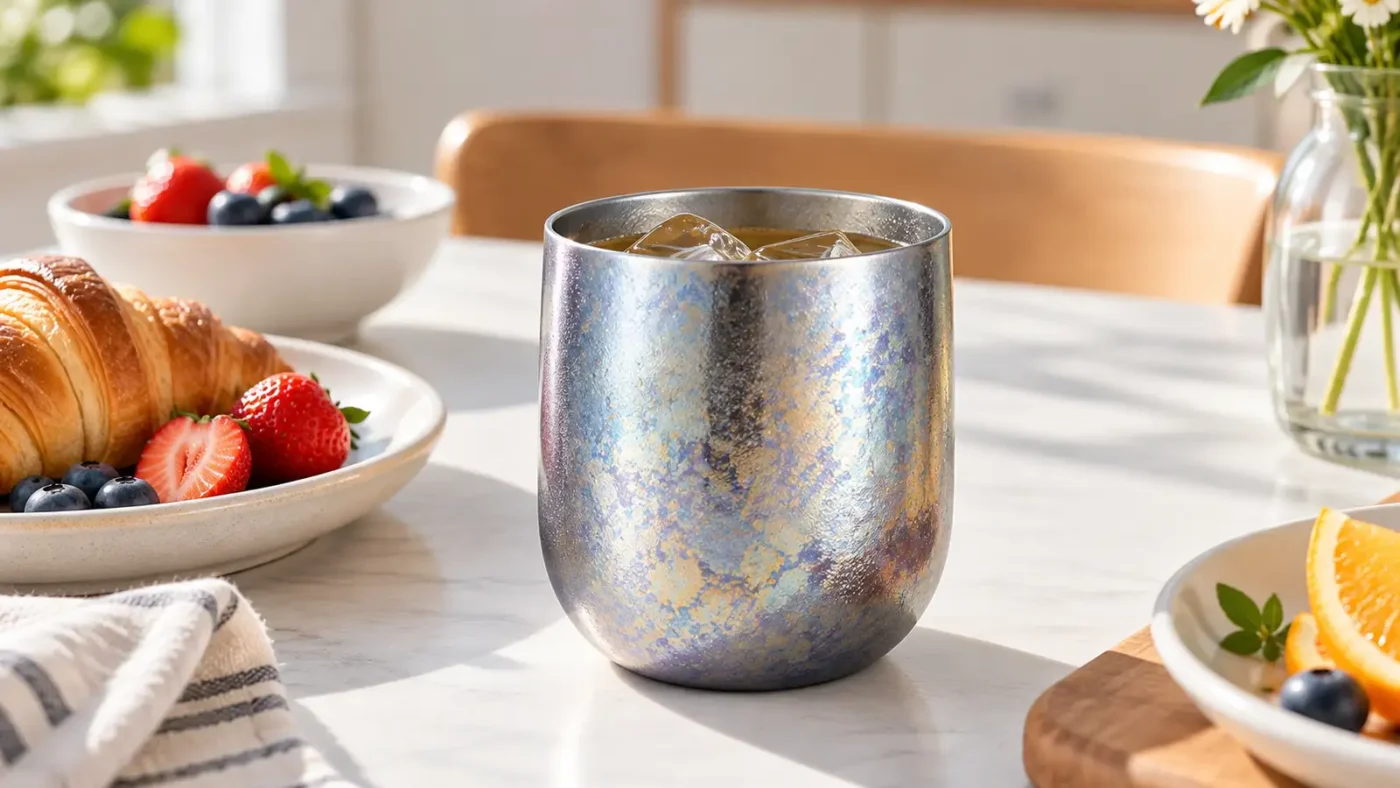
The 260 ml version is listed at 8 cm / 3.1 in in diameter and 9 cm / 3.5 in high. The 400 ml version is listed at 9 cm / 3.5 in in diameter and 11 cm / 4.3 in high.
TiRoam describes both as double-wall, handle-free tumblers suitable for coffee, tea, water, and cold drinks. The smaller size may suit a shorter coffee or tea serving, while the larger size provides more room for water, iced drinks, or a longer drink break.
A tumbler’s handle-free form reduces its overall width, but it also means the exterior is the gripping surface.
Choose a tumbler when:
- You prefer a rounded, handle-free cup
- You want a choice between a smaller and larger serving
- A compact footprint matters more than having a handle
Where Does a Folding-Handle Mug Fit?
A folding-handle mug fits between a simple cup and a fixed-handle mug: it provides handles during use and lets them fold against the body for more compact storage.
The TA1 Pure Titanium Folding Mug uses folding handles. The handles fold; the titanium cup body itself does not collapse.
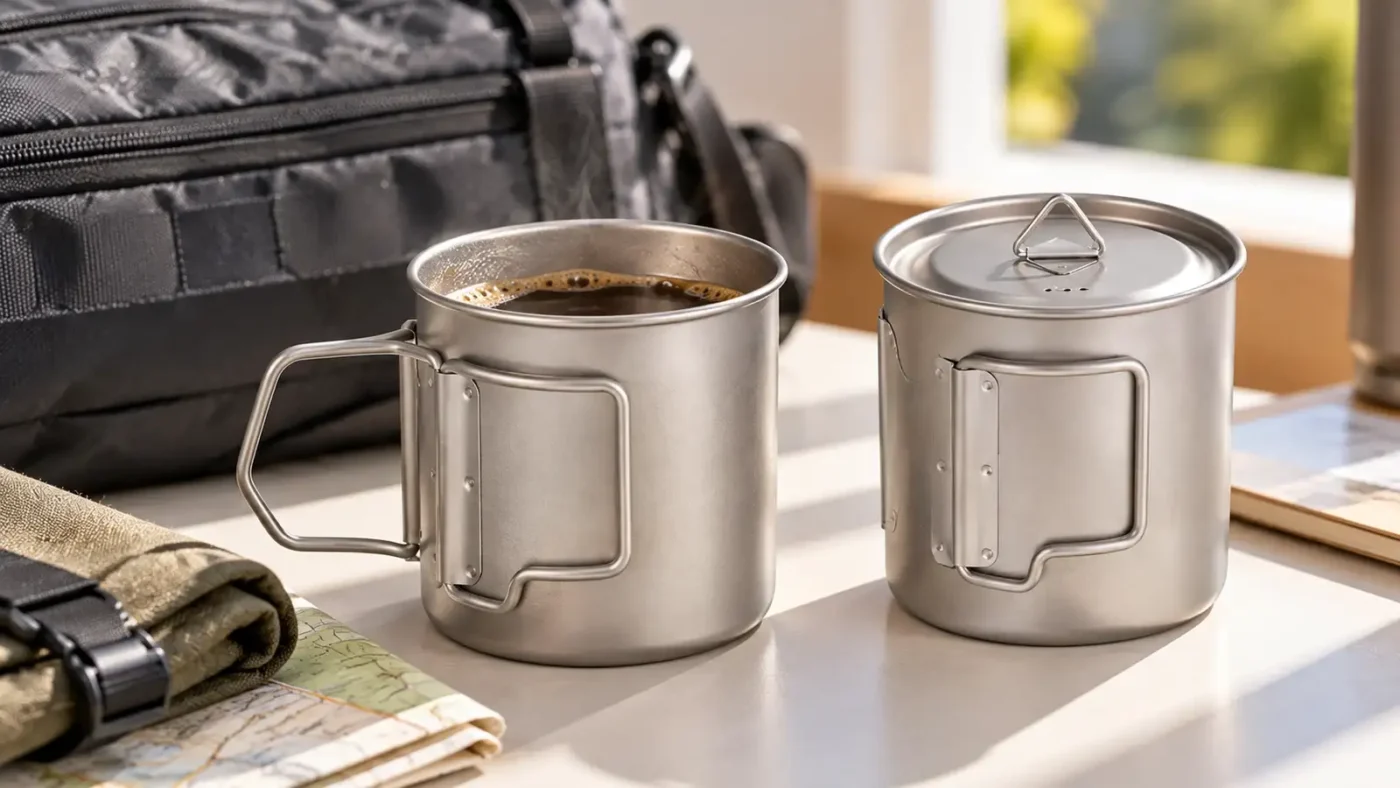
That distinction matters because “folding mug” and “collapsible cup” are not interchangeable descriptions. A folding-handle mug reduces the space occupied by the handles, but its body keeps the same dimensions.
This format may fit your routine when:
- You want a handle but have limited bag or cabinet space
- A fixed handle would catch on nearby items
- You are comfortable unfolding and cleaning around the handle attachment points
Check the selected capacity and its corresponding dimensions on the product page before buying. Different size variants should not be assumed to share the same measurements or weight.
Does Wall Construction Change the Choice?
Yes, but it is a separate decision from choosing between a cup, mug, and tumbler. The format decides handle, shape, and storage; wall construction affects how the outside of a vessel may feel with a hot drink.
A product can be:
- Handle-free or handled
- Single-wall or double-wall
- Double-wall without being identified as vacuum construction
- Double-wall vacuum, when the product specifically says so
Do not use “double-wall” and “vacuum” as automatic synonyms. TiRoam’s current tumbler is described as double-wall, while the current coffee mug is specifically described as double-wall vacuum. The format name does not identify the construction either: a mug is not automatically double-wall, and a tumbler is not automatically vacuum.
For a focused explanation of these structures, read Single-Wall vs. Double-Wall Titanium Mugs: Which Should You Choose?. That article covers construction; this guide remains focused on choosing a drinkware format.
Regardless of construction, check the exterior temperature before handling a vessel filled with a very hot drink. Material alone does not tell you how warm the outside will feel; wall construction, drink temperature, fill level, and time all matter.
Compare Capacity With the Drink You Actually Pour
Choose capacity around your usual serving, not the largest option available. Extra volume can be useful, but it also changes the product’s height, diameter, filled weight, and storage requirements.
The current examples illustrate the range:
- Stackable cup: 330 ml / 11.1 fl oz
- Tumbler: 260 ml / 8.8 fl oz or 400 ml / 13.5 fl oz
- Fixed-handle coffee mug: 430 ml / 14.5 fl oz
A smaller tumbler may suit a short coffee, tea, or modest cold drink. The 330 ml cup sits between the tumbler sizes. The 400 ml tumbler and 430 ml mug offer more capacity, but their shapes and handling remain different.
Capacity does not represent a mandatory fill level. Leaving space below the rim can make a drink easier to carry across a room and reduce the chance of spilling while stirring.
Also consider the filled weight. Even when the empty vessel is light, the beverage adds substantial weight. The everyday experience depends on the complete filled cup, not the material specification alone.
Think About Where You Will Use and Store It
The best format fits the full daily route from cabinet to sink. A cup that feels comfortable in the hand can still be inconvenient if it does not fit the intended shelf, bag pocket, or work surface.
At Home
A stackable cup can help organize several pieces in a cabinet. A fixed-handle mug provides familiar handling but needs more horizontal room. A tumbler offers a simple footprint when you do not need a handle.
At the Office
Measure the available desk space and consider how close the drink will sit to a keyboard or documents. A handle can make repositioning easier, while a handle-free tumbler occupies less width.
No open cup, mug, or tumbler should be treated as a sealed commuting container unless the manufacturer specifically documents an appropriate closure and transport use. If sealed transport is the main requirement, a water bottle may be a better category. TiRoam’s titanium water bottle buying guide explains the separate questions of bottle opening, cap, carry loop, and maintenance access.
During Travel
A stackable cup can work when packing several cups together. A folding-handle mug can reduce handle bulk. A handle-free tumbler may fit into a simple packing setup, but verify its dimensions rather than assuming it fits a particular pocket or holder.
Check Cleaning and Care Before Choosing
Every format needs cleaning around its actual shape and components. A simple handle-free cup has fewer exterior features, while fixed or folding handles create additional areas to wash and dry.
TiRoam’s current product pages recommend washing before first use, hand washing for the best long-term finish, and drying thoroughly before storage. Follow the instructions for the exact finish and model.
Pay particular attention to:
- The interior base and sidewall transition
- The drinking rim
- The area around fixed handles
- Folding-handle attachment points
- Any included component specifically shown on the product page
Avoid using aggressive abrasives when preserving the finish matters. For broader care guidance, see How to Clean Pure Titanium Kitchenware.
Titanium Cup vs Mug vs Tumbler: A Practical Way to Decide
Choose by eliminating the formats that do not fit your routine.
- Do you want a handle? Choose a fixed-handle mug for familiar daily handling or a folding-handle mug when packed space matters. Choose a cup or tumbler if you prefer holding the body.
- How much do you normally drink? Compare the actual capacities rather than assuming all cups, mugs, and tumblers hold similar amounts.
- Does compact storage matter? Consider a verified stackable cup or folding-handle mug. Do not assume unrelated models stack or collapse.
- Which wall construction do you want? Verify whether the exact product is single-wall, double-wall, or explicitly double-wall vacuum.
- Will the drinkware remain open during use? If you need a sealed vessel for commuting, look at bottles instead of assuming a tumbler or mug is leak-resistant.
- Does it fit the complete routine? Check cabinet space, packed dimensions, desk space, cleaning access, and drying before deciding.
No single format is best for every person. Choose the cup for stackable simplicity, the mug for a dedicated handle, or the tumbler for a streamlined handle-free shape. Then confirm the capacity and construction on the exact product.
Browse the current TiRoam Titanium Drinkware collection to compare available cups, mugs, tumblers, and water bottles without treating those product types as interchangeable.
Frequently Asked Questions
Is a Tumbler the Same as a Mug?
Not exactly. A mug normally emphasizes a handle, while a tumbler is commonly handle-free. The terms are not strict standards, so check the actual product details instead of relying on the name.
Do All Titanium Cups Stack?
No. Stackability is a feature of a specific design. The current Stackable Pure Titanium Cup is designed to stack, but fixed-handle mugs and handle-free tumblers should not be assumed to.
Which Type Is Best for Everyday Use?
Choose a stackable cup for compact storage, a mug when you prefer a handle, or a tumbler when you want a streamlined handle-free shape. Then compare capacity and wall construction on the exact product page.
Can I Use an Open Cup, Mug, or Tumbler for Sealed Commuting?
Only if the manufacturer specifically identifies the product as suitable for sealed transport. A lid alone does not establish that a cup, mug, or tumbler is leak-resistant. If sealed transport is the priority, a water bottle is usually the more appropriate category.
Product specifications referenced in this guide reflect TiRoam’s current product pages. Check the individual product page for the latest dimensions, capacities, construction details, and care instructions.