
Cookware & Food Prep
Do Titanium Cutting Boards Dull Knives? What to Know Before Buying
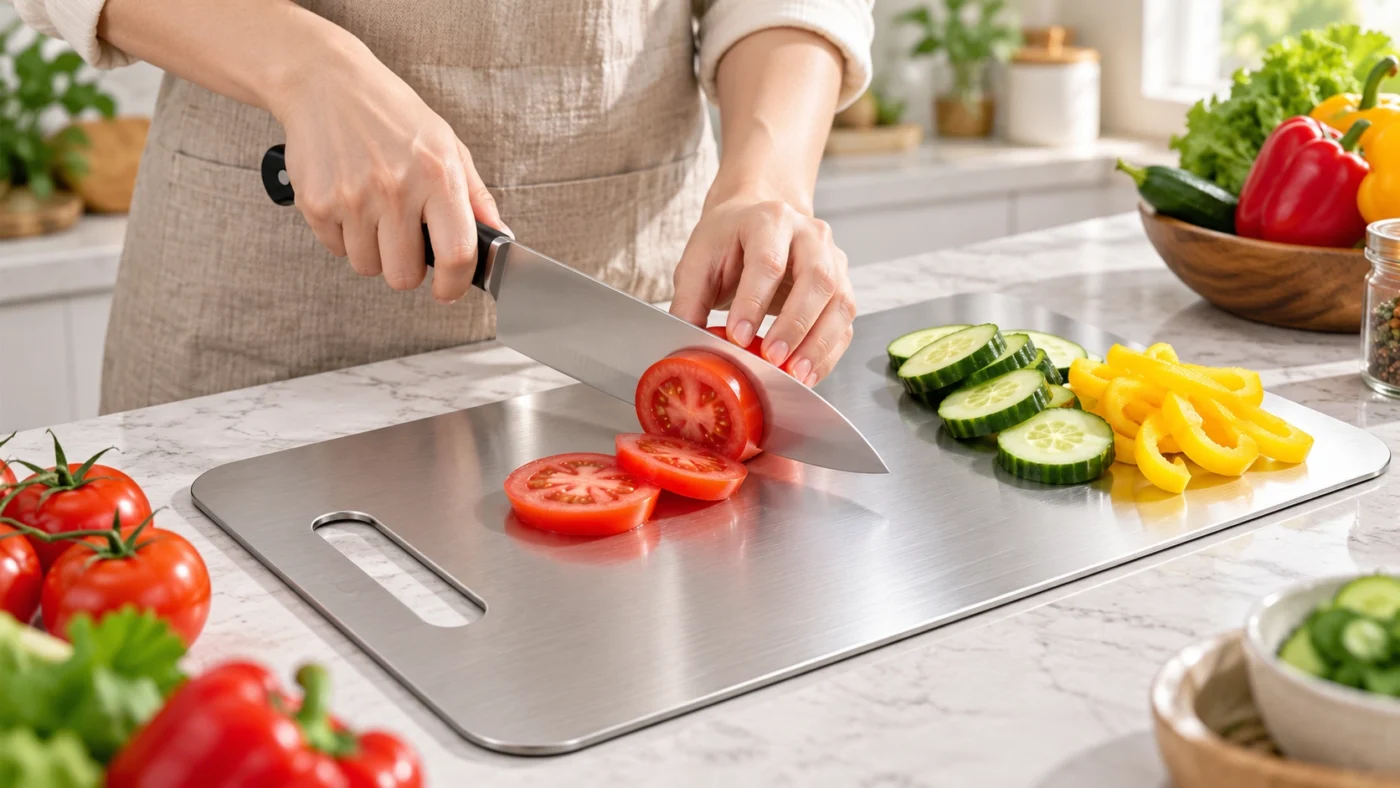
Do titanium cutting boards dull knives? Yes, they can contribute to knife-edge wear. One independent sharpness test found that knives used on a titanium board lost more sharpness than knives used on wood or plastic boards (results below). How quickly an edge loses sharpness depends on the knife, board, cutting technique, and frequency of use.
If you choose titanium, allow for the possibility of additional knife maintenance compared with an appropriate softer cutting surface. The buying decision is whether the board’s material and care requirements offer enough value to make that trade-off acceptable.
Our titanium cutting board pros and cons guide considers knife maintenance alongside the other everyday trade-offs.
Does Being Softer Than Knife Steel Prevent Titanium From Dulling a Knife?
No. A lower material hardness does not establish that a cutting surface cannot wear a knife edge.
A knife’s cutting edge is much thinner than the blade behind it. Comparing the bulk hardness of two materials does not fully describe what happens during repeated contact at that narrow edge.
Blade steel, edge geometry, sharpening angle, cutting pressure, motion, and surface condition all influence the result. A finely sharpened knife and a heavier general-purpose knife may respond differently to the same board.
“Softer than knife steel” is therefore not enough to support a claim that titanium will preserve an edge as well as a suitable wooden or synthetic surface.
Do Material Labels or Board Scratches Prove Knife Friendliness?
No. They describe aspects of the board, rather than demonstrating how well a knife retains its edge.
| Pure titanium material specification | The stated composition of the specified board body or component. | How quickly a particular knife will lose sharpness. |
| Smooth, brushed, or textured finish | How the board’s surface is finished. | A guaranteed level of knife-edge retention. |
| Visible knife marks on the board | The board’s surface has changed during use. | That the knife edge remained unchanged. |
A scratched board and a worn knife edge are not mutually exclusive. Both surfaces can change during use.
Likewise, a material certificate addresses composition. It does not replace a performance comparison involving actual knives and cutting surfaces.
For the board-side changes, see Knife Marks on Titanium Cutting Boards: What Changes With Use?.
What One Independent Knife-Edge Test Found
One independent test by Prudent Reviews measured knife sharpness with a BESS edge tester before and after 300 rocking cuts and 300 straight chops on each board. A lower score means a sharper edge.
| Cutting board | BESS score before | BESS score after |
|---|---|---|
| Titanium | 345 | 671–789 (three trials) |
| Stainless steel | 269 | 453 |
| Plastic (polypropylene) | 181 | 246 |
| Edge-grain teak | 264 | 306 |
| Edge-grain maple | 252 | 293 |
| End-grain walnut | 238 | 253 |
A follow-up with a hard Japanese chef’s knife (SG2 steel, 63 HRC) showed the same pattern: 205 to 433 on titanium, versus 131 to 168 on end-grain walnut.
These results come from one reviewer, using specific boards and knives under the conditions described. They do not set a sharpening schedule for every titanium board, but in this test the titanium board was harder on knife edges than wood or plastic.
Be cautious with claims such as “never dulls knives,” “equally gentle as wood,” or “dulls knives a fixed number of times faster” when the supporting method and limitations are unclear.
How Often Will a Knife Used on Titanium Need Sharpening?
There is no dependable sharpening schedule based on cutting-board material alone.
Someone preparing several meals a day with a thin, finely sharpened knife may notice changes sooner than someone using a different knife less frequently. Cutting pressure and technique add further variation.
Pay attention to cutting performance rather than relying on a promised maintenance interval. A blade that no longer cuts comfortably needs assessment according to its own care instructions.
Honing, sharpening, and repairing damage are different tasks. A change in cutting performance does not tell you which one is needed, and routine honing will not correct every edge problem.
If your knife manufacturer advises against metal cutting surfaces, follow that guidance when selecting a board.
If you mainly use thin, hard Japanese knives, consider keeping a wood or rubber board for them and using titanium for other prep.
How Should You Use a Titanium Cutting Board?
Use a stable setup, controlled cutting motions, and a maintenance routine appropriate for your knife.
- Secure the board. Check that it sits flat and does not slide or rock during normal cutting.
- Avoid unnecessary force. Do not use extra pressure to compensate for a knife that needs attention.
- Move ingredients with a scraper. Avoid repeatedly dragging the sharpened edge sideways across the board.
- Match tools to the task. Heavy chopping, bones, and frozen foods require knives and preparation surfaces intended for that work.
These practices support more deliberate use, but they do not establish that knife-edge wear will be eliminated.
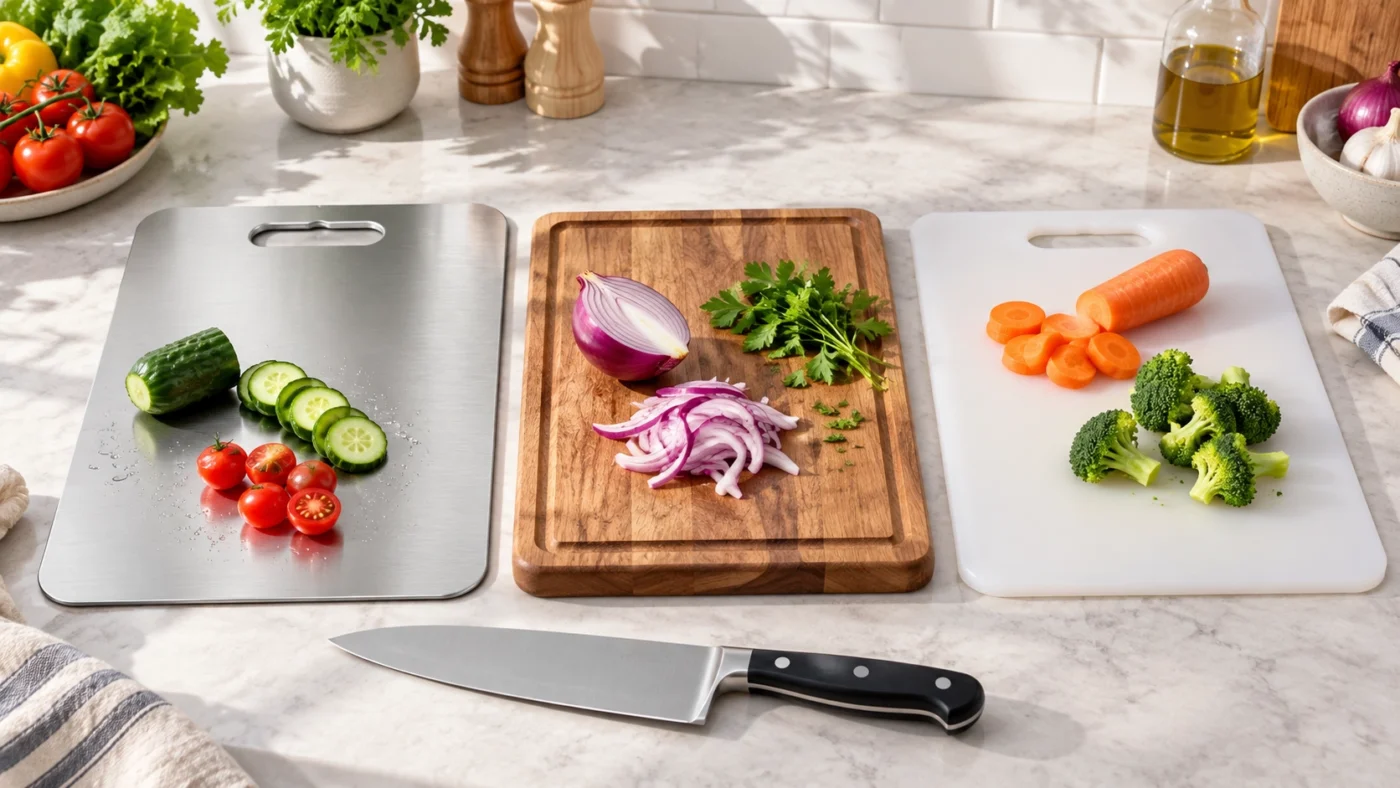
You can also keep different boards for different knives. A softer surface may remain your preference for a thin or finely sharpened blade, while a titanium board serves other suitable preparation tasks.
Are Titanium Cutting Boards Bad for Knives? Who They Suit
Based on the test above, titanium is harder on knife edges than wood or plastic, but that does not make it the wrong choice for every kitchen. A titanium board may suit you if you value a metal preparation surface and accept the possibility of additional knife maintenance. If preserving a fine edge for as long as possible is your main priority, an appropriate softer cutting surface is worth considering.
Keep board maintenance and knife maintenance separate in your decision. A surface that needs no periodic oiling can simplify board care without necessarily reducing the attention your knife requires.
Once you have assessed that trade-off, our Titanium Cutting Board Buying Guide covers dimensions and design features. You can then compare individual models in the TiRoam Titanium Cutting Board collection.