
Cookware & Food Prep
Pure Titanium, Solid Titanium, and Titanium-Coated: What the Labels Mean
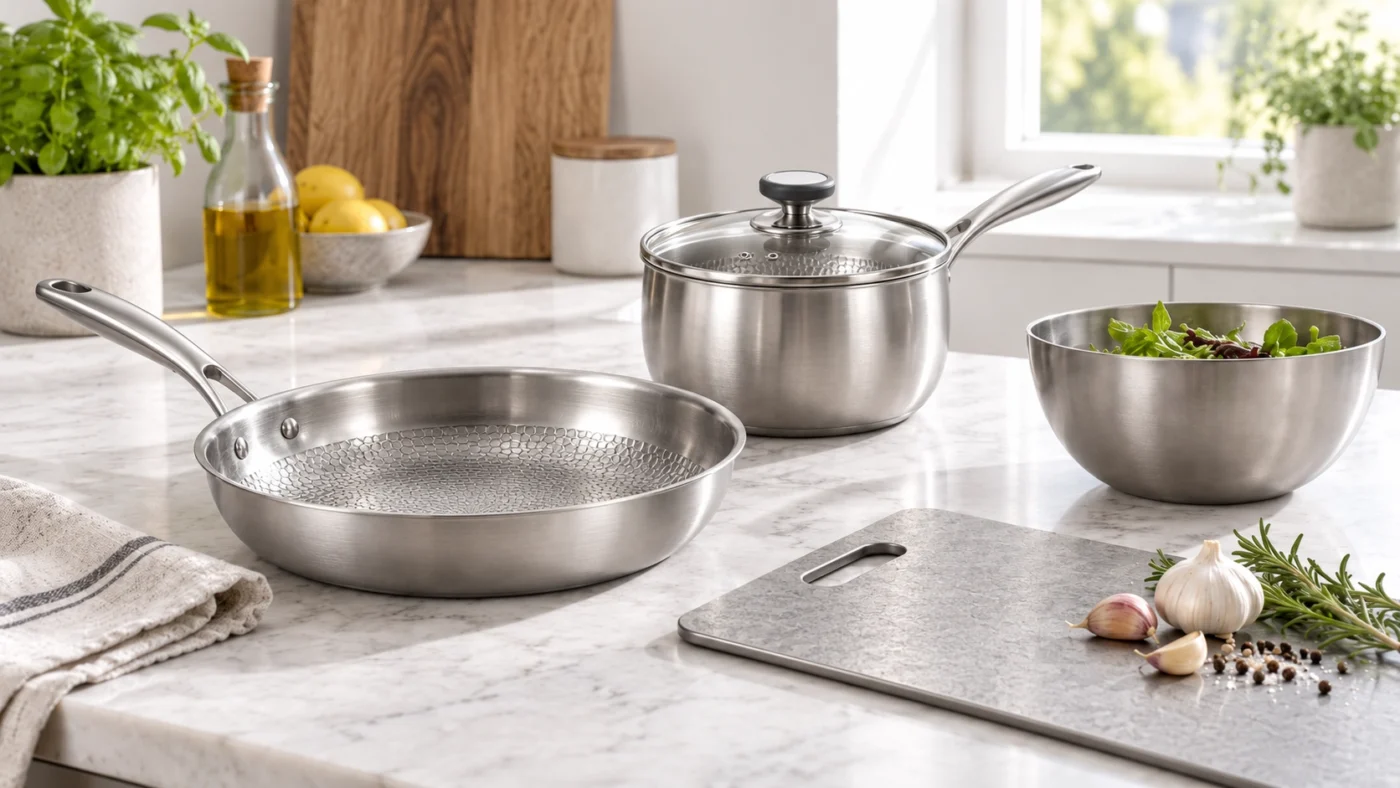
Pure titanium vs titanium coated cookware can be confusing to compare. One product says pure titanium, another says solid titanium, and a third highlights a titanium coating.
These terms do not describe the same thing.
Pure titanium describes material composition. Solid titanium describes how a specified body or component is constructed. Titanium-coated describes a surface layer or treatment.
To compare products accurately, check where titanium is used and what the rest of the product is made from.
Table of Contents
Pure Titanium vs Titanium Coated: A Quick Guide
| Label | What It Describes | What to Check |
| Pure titanium | Commercially pure titanium used in a specified part | Which part is titanium, and what material grade is specified? |
| Solid titanium | Titanium through the thickness of a specified body or component | Does the description apply to the main body or only one part? |
| Pure titanium cooking surface | Commercially pure titanium at the food-contact surface | What materials form the cookware body beneath it? |
| Titanium-coated | A surface coating or treatment described as titanium-based | What is the surface system, and what material is underneath it? |
| Titanium-reinforced | A coating system that may incorporate titanium-containing material | What is the complete coating system, and what care does it require? |
What Does “Pure Titanium” Mean?
In material specifications, “pure titanium” generally refers to commercially pure titanium.
It does not mean chemically 100% titanium. Commercially pure titanium grades allow controlled amounts of other elements within their specifications and are different from titanium alloys formulated with larger intentional additions.
For shoppers, the important question is where that material is used.
A pure titanium cutting board may have its working body made from titanium.
A frying pan may instead use commercially pure titanium only at the cooking surface while other metals form the structure underneath.
“Pure” identifies the material in the specified part. It does not automatically describe handles, lids, seals, fasteners, or every other component.
Is Solid Titanium the Same as Pure Titanium?
Not necessarily.
Solid describes construction; pure describes composition.
“Solid titanium” generally means that the specified body or component is titanium through its thickness rather than another material with a titanium-related coating applied to the surface.
It does not, by itself, tell you whether that titanium is commercially pure titanium or a titanium alloy. The stated material grade provides that information.
It also does not mean every attached component must be titanium. Handles, lids, seals, and fasteners may use other materials.
A metallic appearance alone cannot establish material composition.
What Does Titanium-Coated or Titanium-Reinforced Mean?
“Titanium-coated” generally describes a surface coating or treatment applied over another material such as aluminum or stainless steel.
“Titanium-reinforced” can describe a coating system that incorporates titanium-containing material for reinforcement. It does not necessarily mean the food-contact surface is a continuous layer of commercially pure titanium.
When a product uses either term, check:
- The underlying material
- The food-contact surface
- The coating or surface-treatment description
- Whether a separate nonstick coating is used
- Recommended utensils and cleaning methods
The cookware body and the surface treatment are separate specifications.
Can a Composite Pan Have a Pure Titanium Cooking Surface?
Yes.
“Pure titanium” describes the material. “Composite” describes the construction.
TiRoam’s Titanium Frying Pan with Pure Titanium Cooking Surface is one example.
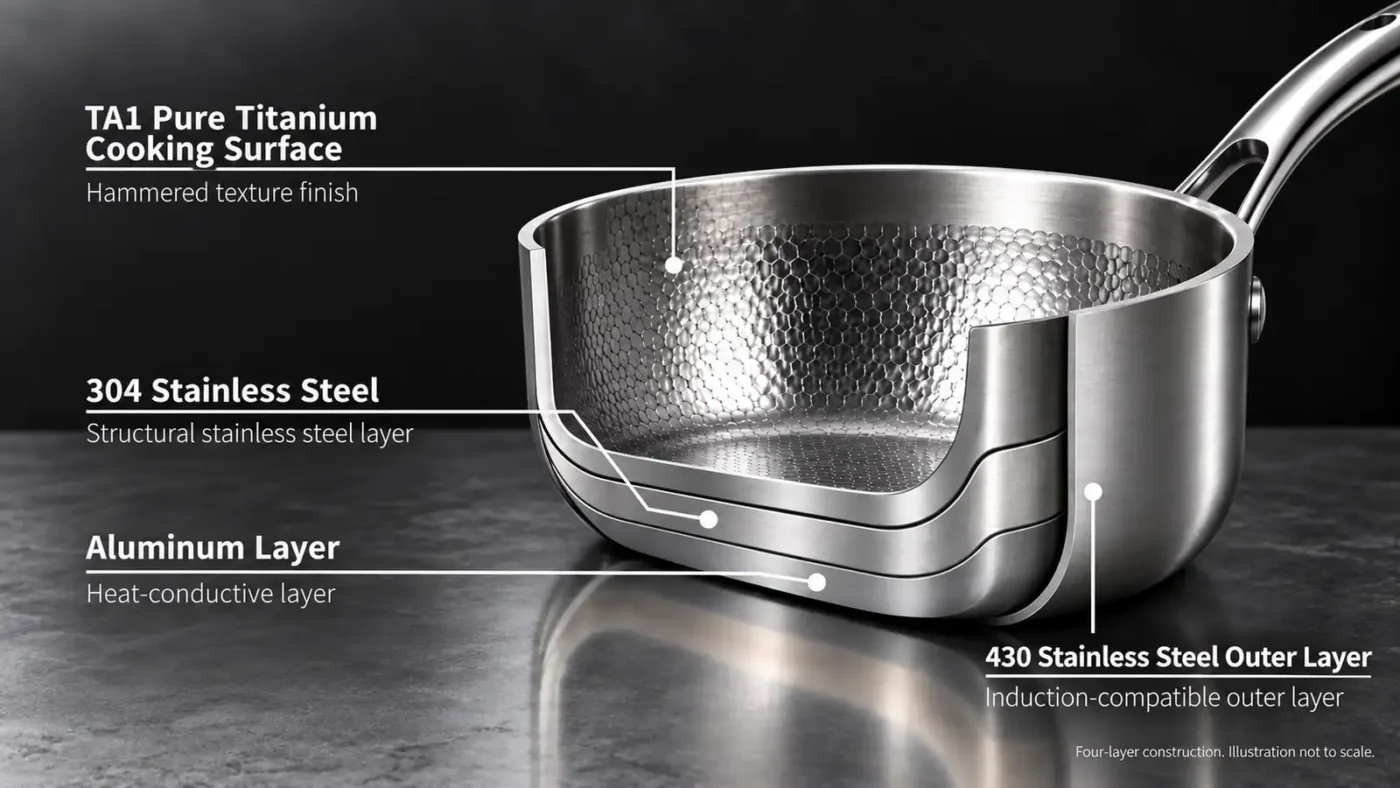
Its cooking surface is TA1 commercially pure titanium, while three additional metal layers form the cookware body beneath it.
From the food-contact surface to the outer layer:
- TA1 commercially pure titanium — food-contact cooking surface
- 304 stainless steel
- Aluminum — heat-conductive layer within the cookware body
- 430 stainless steel — outer layer
The pan is also compatible with induction cooktops.
Here, pure titanium describes the cooking surface, not the entire frying pan.
The complete cooking behavior depends on the finished construction, including layer thickness, bonding, cookware shape, and heat source. Because individual layer thicknesses are not published here, the sequence above describes the materials and their order rather than their relative thickness.
For a deeper comparison of these two construction types, read Solid Titanium vs. Composite Titanium Cookware: Why Construction Matters.
How to Read a Titanium Product Listing
A product name alone rarely tells you everything you need to know. Check four things.
1. Identify the Food-Contact Material
Look for a clear statement explaining what directly touches food.
For cookware, commercially pure titanium cooking surface is more specific than a broad phrase such as “titanium technology.”
For bottles, check the interior material. For cutting boards, check the material used in the working surface and board body.
2. Check the Body Construction
Determine whether the main body is made primarily from one material or combines several materials.
For composite cookware, check which metals are listed and how the construction is described.
For other kitchenware, check handles, lids, seals, and attached components separately.
3. Check for Coatings or Surface Treatments
Do not assume the body material and food-contact surface are the same.
A titanium body, a titanium cooking surface, and a titanium-containing coating describe different constructions.
If the surface treatment matters to you, look for an explicit description rather than relying on the word “titanium” alone.
4. Read the Use and Care Instructions
Titanium does not automatically mean naturally nonstick or compatible with every cooking and cleaning method.
An uncoated titanium cooking surface can still experience sticking. Heat level, preheating, oil, food moisture, surface condition, and timing all affect food release.
For buying expectations, read Does Titanium Cookware Stick? What to Expect Before You Buy.
For practical cooking technique, see How to Cook on a Pure Titanium Surface: Heat, Oil, and Timing.
What About Titanium Alloys?
A titanium alloy combines titanium with other elements in specified proportions to achieve particular properties.
That is different from commercially pure titanium and also different from titanium-coated cookware.
You do not need to memorize every titanium grade. Start with three questions:
- What material is being described?
- What directly contacts the food?
- How is the product constructed?
Those answers usually tell you more than the word “titanium” by itself.
Frequently Asked Questions
Does pure titanium mean 100% titanium?
No.
Commercially pure titanium grades allow controlled amounts of other elements within their material specifications. “Pure titanium” should not be interpreted as a claim of chemically 100% titanium.
Does a pure titanium cooking surface mean the pan is nonstick?
No.
An uncoated titanium cooking surface should not be treated as a guarantee of nonstick performance. Cooking temperature, oil, ingredients, surface condition, and timing all affect food release.
Read the Label, Then Check the Specification
When a product says titanium, check whether the term refers to the main body, the food-contact surface, a specific component, or a coating system.
Then check the material grade, construction, surface treatment, and use instructions.
For a broader material comparison, read Pure Titanium vs. Stainless Steel Kitchenware: Which Fits Your Routine?