
Cookware & Food Prep
Solid Titanium vs. Composite Titanium Cookware: Why Construction Matters
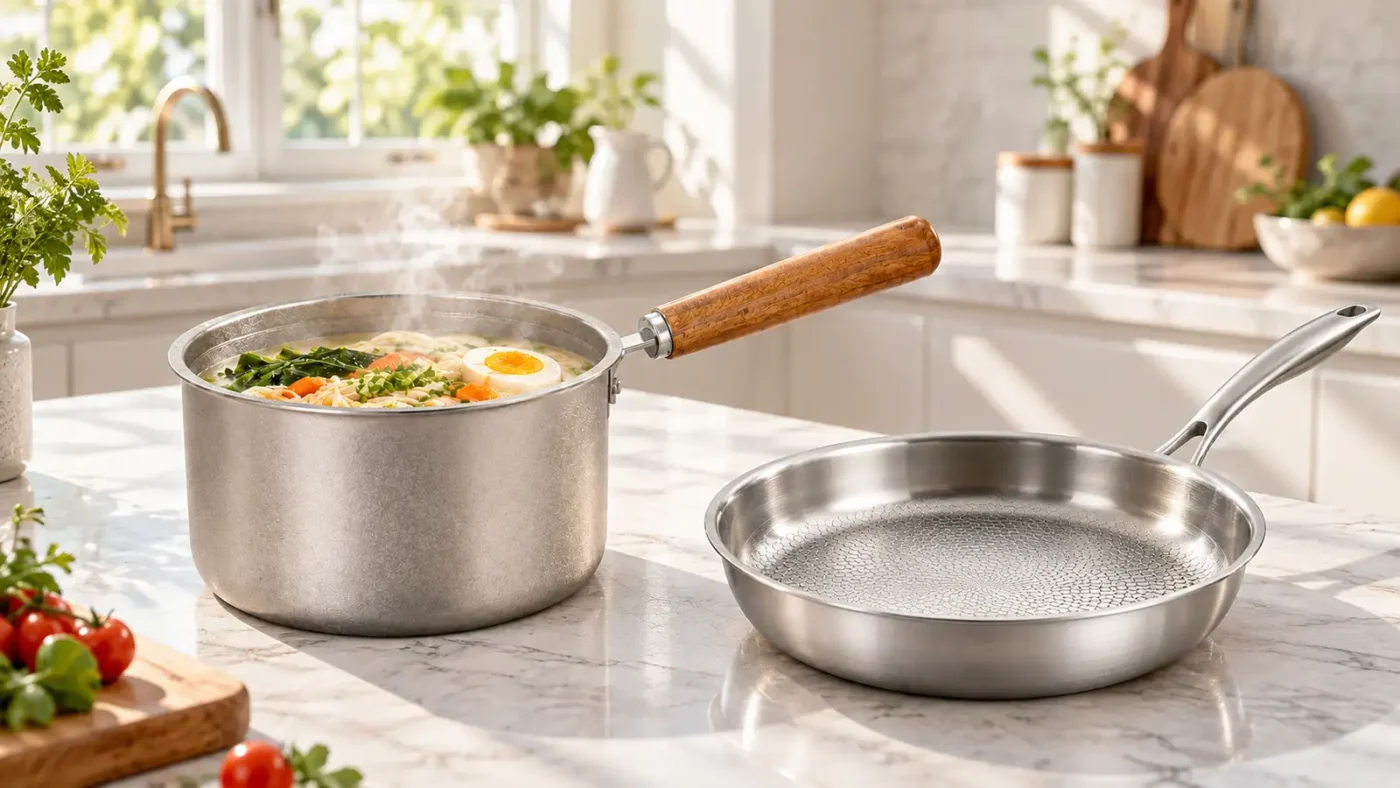
Solid titanium vs composite titanium cookware is primarily a comparison of body construction. Solid titanium cookware generally uses titanium for its main body. The composite construction discussed here combines a titanium food-contact surface with other metal layers beneath it.
The distinction matters because the surface touching food and the rest of the body serve different roles. The food-contact surface determines the material your ingredients touch. The complete construction influences heat transfer, weight, and cooktop compatibility.
Start with those separate specifications when comparing products sold as “titanium cookware.”
Table of Contents
Solid Titanium vs Composite Titanium Cookware: Key Differences
| Feature | Solid titanium cookware | Composite titanium cookware discussed here |
|---|---|---|
| Main body | Primarily titanium rather than bonded layers of different metals | Titanium combined with other metals |
| Food-contact surface | Titanium when the interior is uncoated | A specified titanium layer at the cooking surface |
| Heat transfer | Depends on titanium grade, thickness, shape, and heat source | Also depends on the materials, thickness, coverage, and bonding of the layers |
| Weight | Can suit lightweight construction; check actual specifications | Depends on the complete layer arrangement, dimensions, and hardware |
| Cooktop compatibility | Must be confirmed for the specific product | Must be confirmed for the specific product |
| What to verify | Body material, surface treatment, weight, and heating instructions | Food-contact material, layer sequence, layer coverage, and heating instructions |
This table describes construction differences, not measured performance rankings. Neither label establishes how a particular pan will cook.
What Does Solid Titanium Cookware Mean?
“Solid titanium cookware” generally describes a main body made primarily from titanium rather than a layered combination of different metals.
It does not necessarily mean that every component is titanium. Handles, fasteners, lids, and other attached parts may use different materials.
An uncoated titanium interior provides a titanium food-contact surface. Check the product description rather than assuming that the body material also establishes the absence of a coating or treatment.
Solid titanium cookware can be designed for relatively low weight, but finished weight still depends on dimensions, thickness, handles, and other components. However, titanium conducts heat less effectively than aluminum. In a thin titanium pan, heat may spread less readily away from the area directly above the burner.
The result still depends on thickness, shape, burner size, and heat level. “Solid titanium” alone does not predict the presence or severity of hot spots.
What Is Composite Titanium Cookware?
Composite titanium cookware combines titanium with other materials within the body. In the construction discussed here, titanium forms the food-contact surface, while other metal layers contribute to the body’s overall properties.
This allows a manufacturer to combine a titanium cooking surface with materials such as aluminum that help spread heat through the cookware body.
The terms “composite,” “clad,” and “multi-ply” do not fully explain a product’s construction. Check which materials are used and whether the layers extend through the base, sidewalls, or both.
Do not assume full sidewall coverage or a particular layer thickness when the manufacturer has not specified it.
How Is TiRoam’s Titanium Frying Pan Constructed?
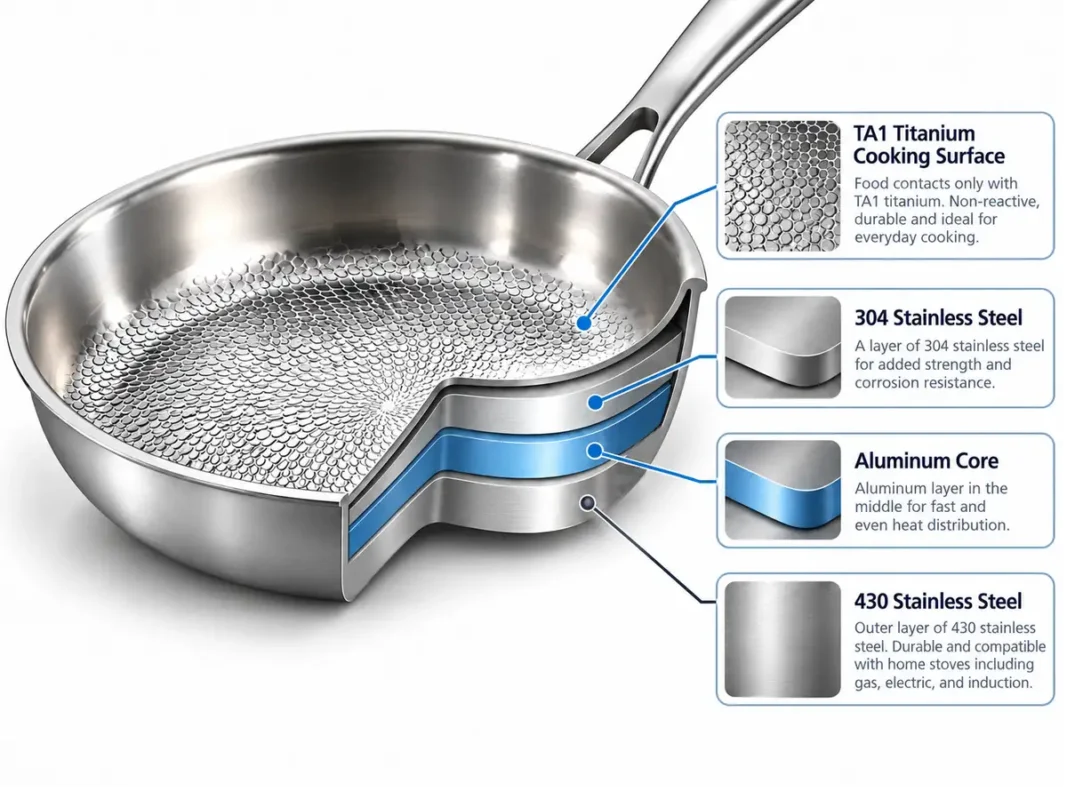
TiRoam’s Titanium Frying Pan uses a TA1 commercially pure titanium food-contact surface within a composite body. “Pure titanium” describes the cooking surface, not the entire pan body.
For the frying pan discussed here, the layer sequence runs from the food-contact surface outward:
| Layer | Material | Position or function |
|---|---|---|
| 1 | TA1 commercially pure titanium | Food-contact cooking surface |
| 2 | 304 stainless steel | Internal stainless steel layer |
| 3 | Aluminum | Heat-conductive layer within the body |
| 4 | 430 stainless steel | Outer layer |
The product page explicitly lists compatibility with induction cooktops, as well as gas, electric, ceramic, and radiant cooktops.
This specification applies to the identified frying pan. It should not be used to describe every TiRoam cookware product or every pan marketed as titanium.
How Does Construction Affect Cooking?
Materials and their arrangement influence cooking behavior, but layer count alone is not a quality score. Thickness, coverage, bonding, and overall design are more informative than the number of layers.
Heat Distribution
Heat distribution describes how heat spreads across the cooking surface.
An aluminum layer can help spread heat through a composite body because aluminum conducts heat more effectively than titanium. The finished result depends on the layer’s thickness and coverage, together with the surrounding materials.
Burner size matters too. A heat source poorly matched to the pan’s base can contribute to uneven heating. The presence of aluminum does not guarantee perfectly uniform temperatures under every cooking condition.
Heat Response
Heat response describes how the pan reacts when you change the burner setting.
Conductivity, total thickness, and the thermal mass of the construction influence that response. A thin pan may heat quickly, while a construction with greater heat capacity may continue transferring substantial heat after the burner is reduced.
Compare finished-product information where available. Without product-specific testing, construction alone cannot establish exact heating times or temperature differences.
Weight and Handling
Finished weight depends on dimensions, thickness, materials, handles, and other components.
Do not assume that every solid titanium pan is lighter than every composite model. Compare actual weights for similarly sized cookware, then consider balance and handle comfort.
A pan that feels manageable when empty may feel different when filled with food or liquid.

Is Composite Construction the Same as a Titanium Coating?
No. Composite construction describes the body; a coating describes a surface treatment. A pan can have a composite body and a separate coating.
Some products use “titanium” to describe a titanium-containing coating or reinforced nonstick formulation. That does not necessarily mean the food-contact surface is a layer of titanium metal.
Treat body construction, food-contact material, and surface treatment as separate specifications.
For the terminology in more detail, read Pure Titanium, Solid Titanium, and Titanium-Coated: What the Labels Mean.
Does Either Construction Guarantee Nonstick Performance?
No. An uncoated titanium cooking surface can still stick. Neither a solid titanium body nor a composite body establishes nonstick performance.
For buying expectations, see Does Titanium Cookware Stick? What to Expect Before You Buy.
For practical adjustments to heat, oil, and turning time, read How to Cook on a Titanium Surface: Heat, Oil, and Timing.
Those questions are related to construction, but they require more than a material label to answer.
What Should You Check About Care?
Follow the instructions for the complete cookware item. A titanium cooking surface does not establish the cleaning requirements of handles, lids, finishes, or other components.
For TiRoam’s Titanium Frying Pan, the product page advises letting the pan cool naturally, washing with warm water and mild dish soap using a soft sponge or cloth, and drying completely before storage.
It also advises avoiding sudden temperature changes, such as placing a very hot pan under cold running water. Normal use may gradually change the surface’s appearance.
For detailed cleaning methods, see How to Clean Pure Titanium Kitchenware.
Which Construction Fits Your Cooking Routine?
Choose between solid titanium and composite titanium cookware by comparing the actual product with the tasks you cook most often.
A primarily titanium body may suit you when low weight and simpler construction are priorities. A composite body may suit you when you want a titanium cooking surface combined with other materials selected for heat transfer and support.
For a frying pan used regularly at home, compare usable cooking area, heat control, handle comfort, finished weight, and compatibility with your stove. A pot used mainly to boil water may call for a different balance of features.
For a full selection checklist, use our guide to choosing titanium cookware for everyday cooking.
Before buying, confirm the food-contact surface, body construction, cooktop compatibility, finished weight, and care instructions for the exact product.
To compare available sizes and current specifications, view the TiRoam Titanium Frying Pan with Pure Titanium Cooking Surface.