
Cookware & Food Prep
Are Titanium Cutting Boards Good? Practical Pros and Cons
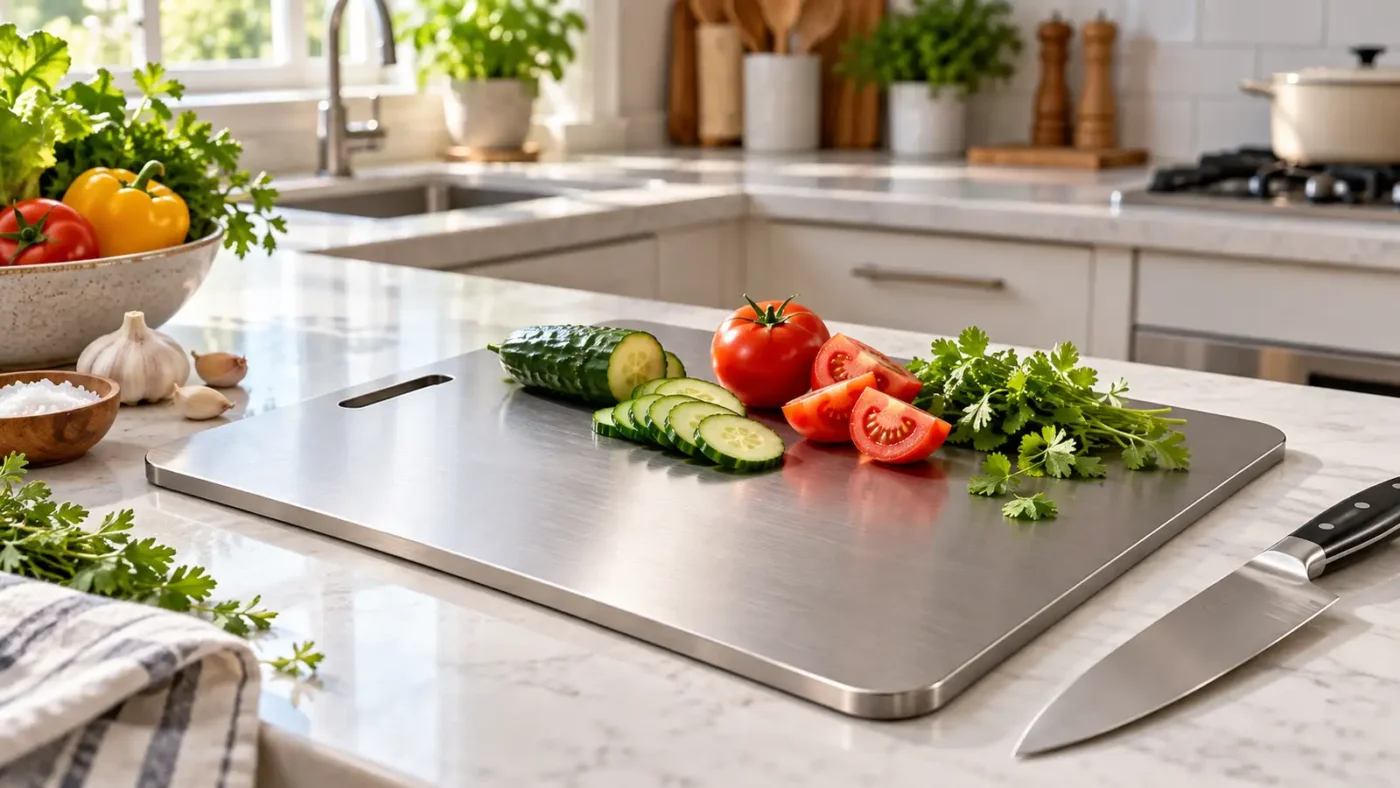
Are titanium cutting boards good for everyday kitchen prep? They can be, provided the finished board suits your knives, workspace, and routine. A titanium board does not require periodic oiling, and some thin designs can simplify storage. Knife-edge wear, visible surface marks, and countertop stability are the main trade-offs to consider.
Think about an ordinary meal: preparing ingredients, moving food to the pan, washing the board, and putting it away. Those steps reveal whether a board fits your kitchen more clearly than the material name alone.
Practical Advantages of Titanium Cutting Boards
No Periodic Oiling or Seasoning
A titanium cutting board does not need the periodic oiling used to maintain many wooden boards.
That removes one maintenance task. You still need to wash the board after preparation and follow the exact model’s cleaning instructions.
For example, TiRoam’s Integrated-Handle Pure Titanium Cutting Board calls for cleaning with warm water and dish soap using a soft sponge or cloth, followed by thorough drying before storage.
This can suit someone who prefers a board maintained through regular washing and drying. It does not make the surface self-cleaning or remove the need to clean areas where food residue collects.
Some Designs Can Simplify Storage
A thin titanium board may fit a storage space that cannot accommodate a thick chopping block. That can be useful when you need to put the board away between meals.
This benefit belongs to the specific design. Check the actual thickness, overall dimensions, and available storage space rather than judging the board from a photograph.
A slim board can still be large or heavy enough to feel awkward at the sink. Consider whether you can lift it, turn it to wash both sides, and place it in your drying area comfortably.
An integrated handle may make moving the board easier, but its usefulness depends on the opening, grip, and finished weight.

Trade-Offs to Understand Before Buying
Knife Compatibility Deserves Attention
Do not choose a titanium cutting board on the strength of a promise that it will never dull knives.
Knife-edge wear depends on the working surface, knife steel, edge geometry, cutting pressure, technique, and frequency of use. The material name alone cannot predict how a particular knife will perform.
If preserving a fine or delicate edge is your leading priority, consider whether an appropriate softer cutting surface would suit that knife better. Follow the knife maker’s guidance and maintain the edge as needed.
For the factors and limits behind this question, read Do Titanium Cutting Boards Dull Knives? What to Know Before Buying.
Visible Knife Marks Can Develop
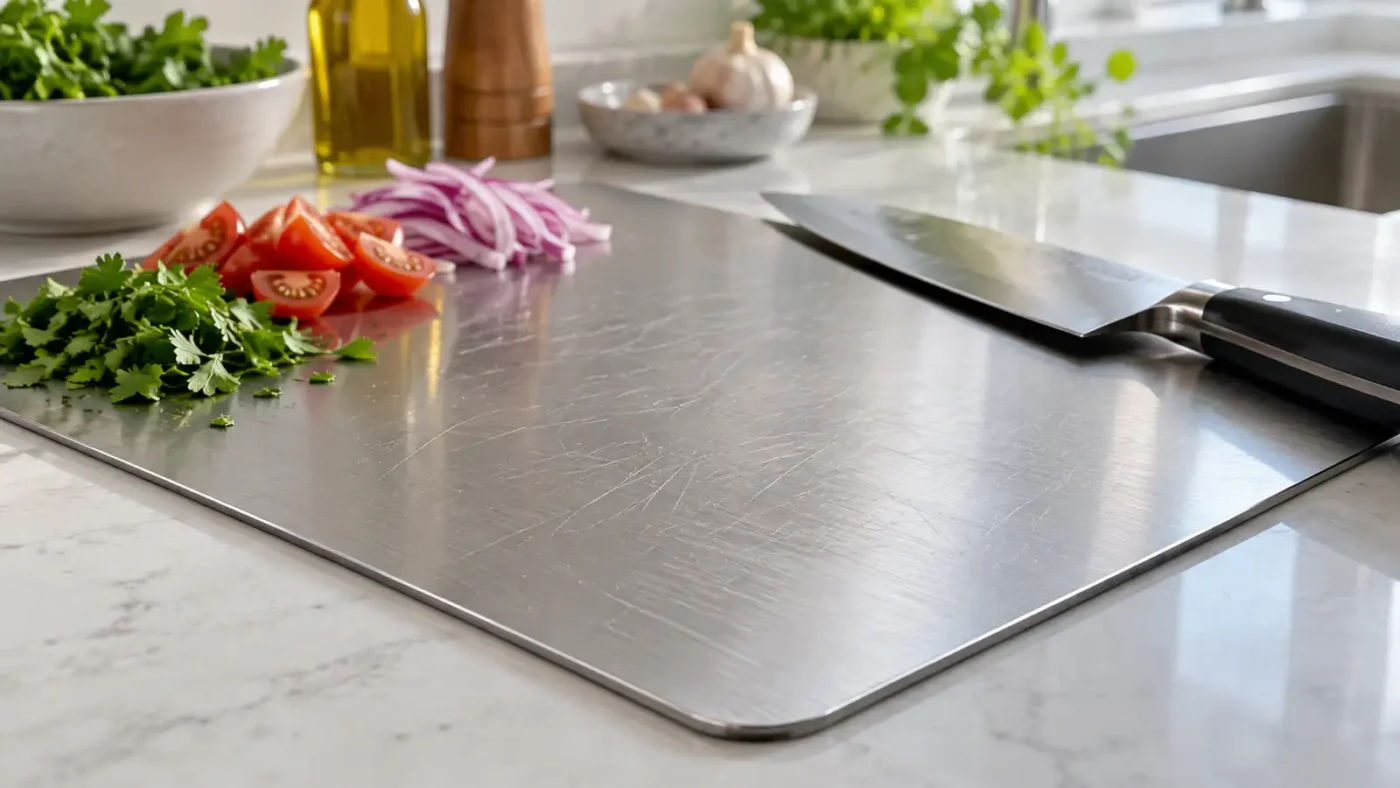
Regular knife contact can leave marks and scratches. A working titanium board should not be expected to retain an unchanged showroom finish.
Visibility can vary with the finish, lighting, viewing angle, and pattern of use. A frequently used area may look different from the perimeter even when the board has been cleaned.
Appearance and physical condition should be assessed separately. A visible line alone does not establish that replacement is needed, but an unfamiliar change that affects handling or cleaning deserves attention.
For inspection guidance, see Knife Marks on Titanium Cutting Boards: What Changes With Use?.
Stability Depends on the Complete Setup
Titanium alone does not determine whether a board will slide or rock. The board’s shape, underside, support, and contact with the countertop all contribute.
Before cutting, check that it sits flat and remains secure under normal pressure. Follow the product instructions for any nonslip support.
Consider the setup you will actually use. A board placed on one countertop may behave differently on another surface, especially if the contact area or support changes.
If it moves unexpectedly or does not sit normally, resolve the cause before continuing. A stable cutting surface matters regardless of the board material.
Cleaning and Food Separation Still Matter
A metal cutting surface does not replace normal cleaning or food separation.
Wash after food preparation, rinse thoroughly, and dry before storage. Pay attention to any groove, handle opening, or other area where residue can remain.
Use separate boards for raw meat, poultry, or seafood and ready-to-eat foods where practical. Do not treat titanium as a substitute for keeping those preparation tasks separate.
Choose cleaning tools and sanitizing methods suitable for the exact product. Dishwasher compatibility should also be checked rather than inferred from the word “titanium.”
For detailed washing and care guidance, read How to Clean Pure Titanium Kitchenware.
Are Titanium Cutting Boards Good for Your Kitchen?
A titanium cutting board may suit you if you want a metal prep surface, no periodic oiling, and a design that fits your washing and storage routine.
It may be less suitable if preserving a delicate knife edge is your highest priority, visible marks would bother you, or the particular board does not work securely on your countertop.
You do not need to replace every board with one material. Different preparation tasks can use different surfaces, and your preferred knife may influence which board you reach for.

Once titanium fits your priorities, read How to Choose the Best Titanium Cutting Board for Your Kitchen to compare usable cutting area, size, grooves, handles, and handling.
You can then compare the current models in the TiRoam Titanium Cutting Board Collection.