
Cookware & Food Prep
Is Titanium Cookware Safe? How to Read Materials and Test Reports
Is Titanium Cookware Safe? How to Read Materials and Test Reports
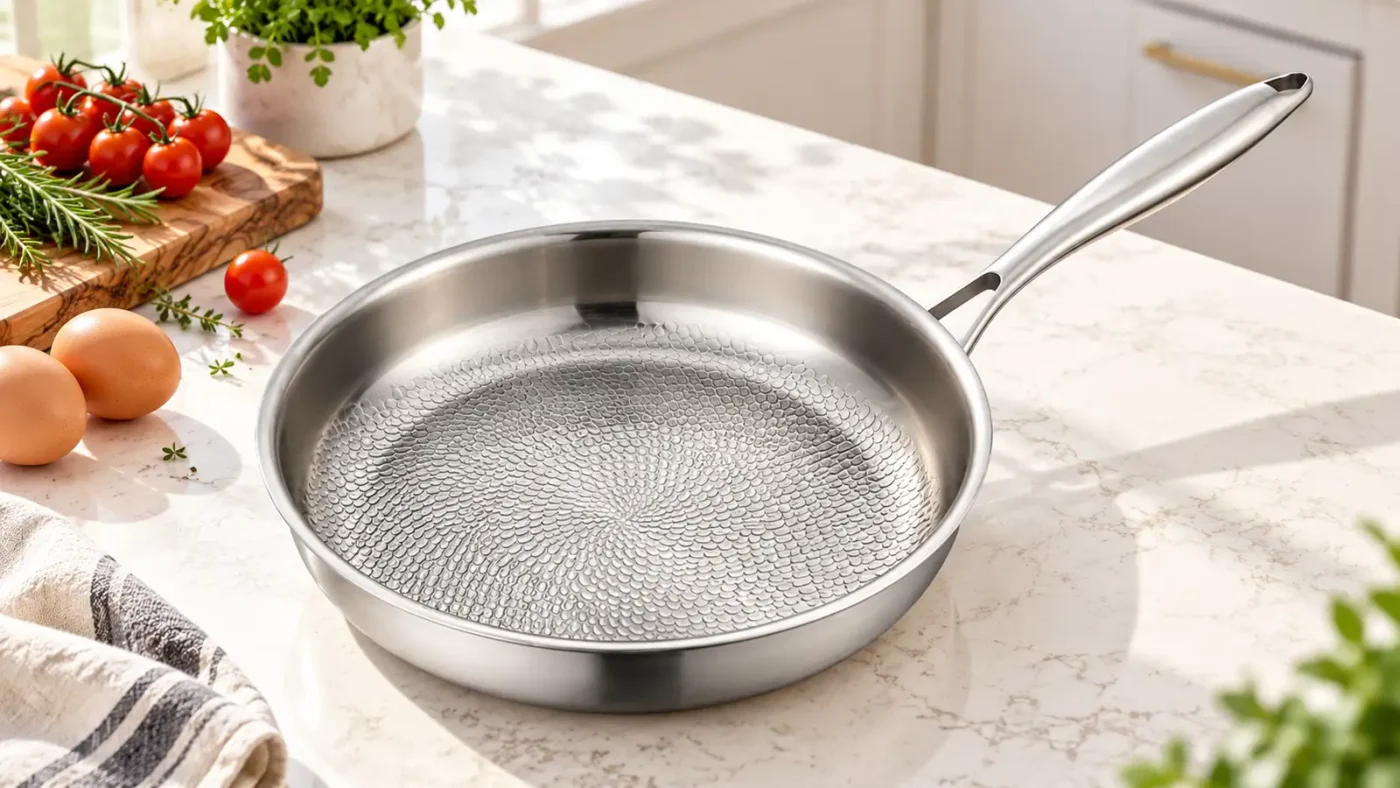
Is titanium cookware safe? It can be suitable for everyday cooking when the finished product uses appropriate food-contact materials, meets applicable requirements, and is used as intended. However, the word “titanium” alone does not establish the safety of a particular frying pan or saucepan.
To evaluate titanium cookware, start with three questions:
- What material comes into direct contact with food?
- Do the supporting test reports match the exact product?
- What cooking, heating, and cleaning conditions does the manufacturer recommend?
These questions help distinguish documented product characteristics from general marketing claims.
Start With the Surface That Touches Food
Not all products marketed as titanium cookware have the same construction.
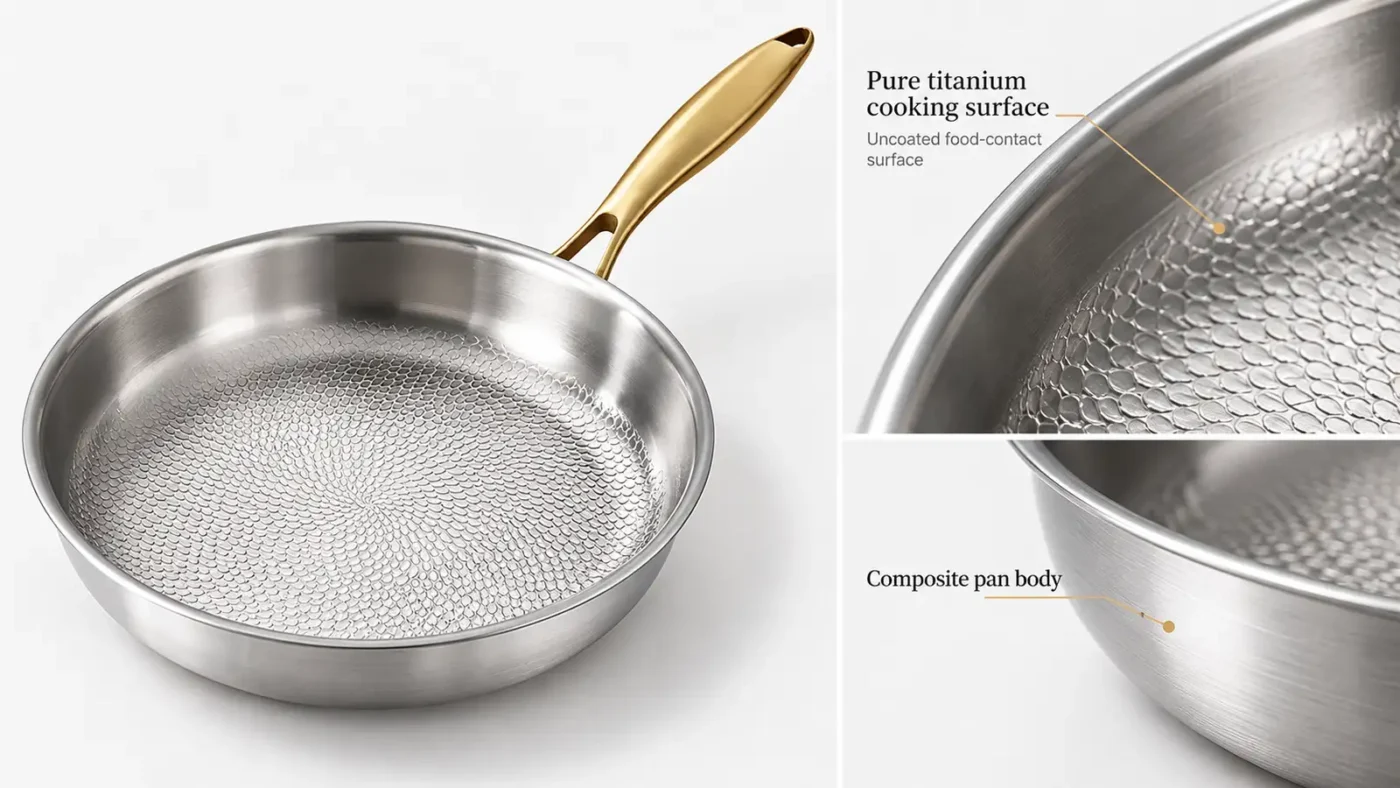
A pure titanium cooking surface, a solid titanium pan, and a titanium-containing coating describe different material arrangements.
A composite frying pan may use a pure titanium cooking surface supported by other metal layers. That does not mean the entire pan, including its handle and lid, is made from titanium.
Similarly, the presence of stainless steel or aluminum in the supporting structure does not necessarily mean those materials directly touch food.
When evaluating a product, check:
- The material of the food-contact surface
- The construction of the pan body
- Whether any coating or surface treatment is present
- The materials used in the lid, handle, and other components
For a closer look at these distinctions, read our guide to pure titanium, solid titanium, and titanium-coated cookware.
You can also explore the differences between solid titanium and composite titanium cookware.
How to Check Titanium Cookware Test Reports
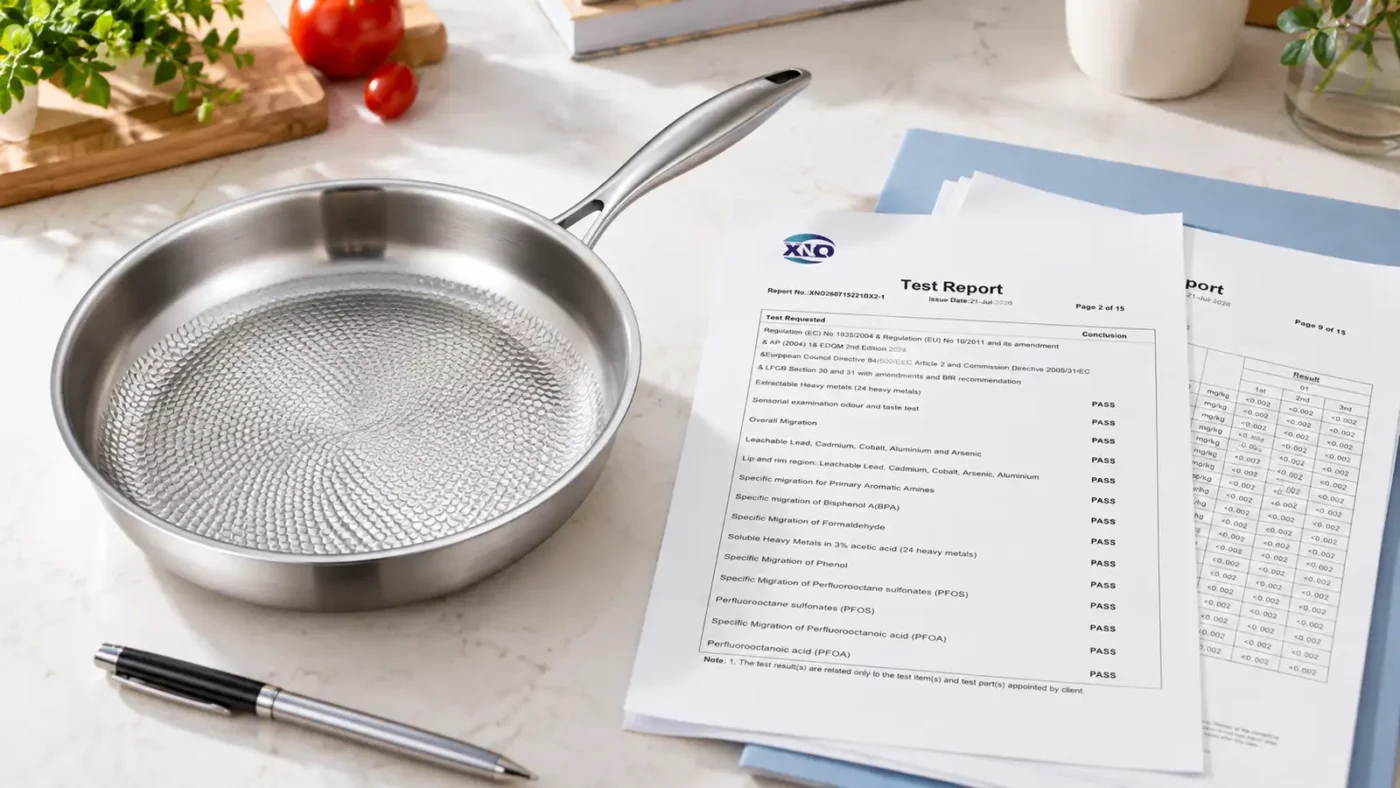
A test report is useful only when its results can be connected to the product being evaluated.
Before relying on a report, check the laboratory name, report number, issue date, tested sample, product model, and photographs.
A report for one frying pan does not automatically cover every size or design offered by the same manufacturer.
For example, if a 26 cm frying pan was tested, check whether the documentation explicitly includes the 24 cm and 28 cm versions.
Different products may share a supplier or a general product name while using different components, finishes, or manufacturing specifications.
Where possible, request the complete report rather than relying on a single summary page.
What Do Different Cookware Tests Measure?
Not every laboratory test evaluates food-contact suitability.
| Evidence Type | What It Helps Establish | What It Does Not Prove |
|---|---|---|
| Material composition | The composition of an identified material or component | Safety under every cooking condition |
| Migration or extraction testing | What transfers from the tested sample under specified conditions | Results for untested components or conditions |
| Heat or mechanical testing | Performance under the stated test procedure | Overall food-contact compliance |
Always identify which component was tested.
A frying pan, glass lid, and metal handle may require different evaluations. A passing result for one component should not be presented as evidence covering every part of the finished product.
Also distinguish between information supplied by the applicant and measurements independently established by the laboratory.
Why Test Conditions Matter
Food-contact testing is performed under defined conditions.
Depending on the test, those conditions may include:
- Contact temperature and duration
- Food simulants or extraction liquids
- The tested surface area
- Specific substances or measurements
- Repeated exposure procedures
- Applicable acceptance limits
These details determine how the results should be interpreted.
A laboratory test using a particular liquid and temperature does not automatically represent every recipe or cooking method.
For example, briefly frying an egg and leaving an acidic sauce in a pan for several hours involve different contact conditions.
The same distinction applies to heating performance. A food-contact migration test does not establish that cookware is suitable for unlimited oven temperatures or prolonged empty-pan preheating.
For additional context, the U.S. Food and Drug Administration explains how food-contact substances are regulated.
What Does “Pass” Actually Mean?
A laboratory result marked “Pass” means that the identified sample met the stated acceptance criteria for the test performed, subject to the report’s qualifications.
It does not mean the product was tested for every possible substance, temperature, or use condition.
Similarly, “Not Detected” is not the same as absolute absence.
It generally means the measured substance was not detected under the stated analytical method and detection limit.
When reviewing a report, check:
- The substance or property tested
- The measurement units
- The detection or reporting limits
- The acceptance criteria
- The sample and component identification
If a report uses an unfamiliar testing standard, verify that the method is applicable to the material and intended food-contact use.
For example, 21 CFR 175.300 addresses resinous and polymeric coatings. If that provision appears in a report for an uncoated titanium surface, its applicability should be clarified rather than assumed.
A passing result should be described according to the actual test scope, not expanded into a broad product certification claim.
Are Titanium Frying Pans Safe for Everyday Cooking?
A titanium frying pan can be appropriate for everyday cooking when its finished construction, food-contact materials, supporting documentation, and intended use are suitable.
The cooking surface is an important part of that evaluation, but it is not the only consideration.
A pan may also contain supporting metal layers, an attached handle, a glass lid, or other components that require separate material descriptions.
The manufacturer’s instructions matter as well.
For everyday stovetop cooking, follow the recommended heat settings and avoid overheating an empty pan.
An uncoated titanium cooking surface should not automatically be treated as a synthetic nonstick surface. Cooking results depend on temperature, oil, ingredients, and technique.
Food-contact testing also does not automatically establish dishwasher compatibility, oven compatibility, or resistance to thermal shock.
Those characteristics should be confirmed through the product’s own specifications and care instructions.
A TiRoam Example: Cooking Surface vs. Pan Construction
The TiRoam Titanium Frying Pan with Pure Titanium Cooking Surface illustrates why construction details matter.
The product uses an uncoated pure titanium food-contact cooking surface within a multi-layer composite body.
Pure titanium describes the cooking surface, not every structural component of the finished pan.
The product listing also identifies its available sizes, cooking-surface design, and compatible stovetop types.
For everyday use, gradual preheating over low to medium heat is recommended. Avoid overheating the empty pan.
After cooking, allow the pan to cool naturally before washing it with warm water, mild dish soap, and a soft sponge or cloth.
Avoid exposing a very hot pan to sudden cold-water cooling.
These product instructions help explain intended use. They do not replace model-specific food-contact testing or establish the scope of any laboratory report.
Supporting documentation should always be checked against the exact product being sold.
A Practical Checklist Before Buying Titanium Cookware
Before purchasing titanium cookware, use this checklist to evaluate the actual product rather than relying on the material name alone.
- Identify the food-contact surface. Is it pure titanium, a titanium-containing coating, or another material?
- Check the complete construction. Are the body layers, handle, lid, and other components clearly described?
- Match the test documentation. Does the report identify the relevant model and tested components?
- Understand the results. What substances, conditions, methods, and acceptance criteria were used?
- Review intended use. Are cooktop compatibility, heating limits, cleaning instructions, and other restrictions clearly stated?
If an important detail is missing, ask the seller for clarification before relying on a broad safety statement.
The Bottom Line: Is Titanium Cookware Safe?
Titanium cookware should be evaluated as a complete product, not simply by the material named in its marketing.
An uncoated titanium cooking surface can be a practical choice for daily meals, but the overall assessment depends on construction, applicable food-contact requirements, relevant testing, and proper use.
The most useful evidence is specific, traceable, and limited to what was actually tested.
Once you understand the material and documentation, our guide to choosing titanium cookware for everyday cooking can help you compare different pan designs.
Explore the TiRoam Titanium Cookware collection to review individual product specifications for everyday home cooking.