
Cookware & Food Prep
Titanium vs. Stainless Steel Cutting Boards: What Changes in Daily Use?
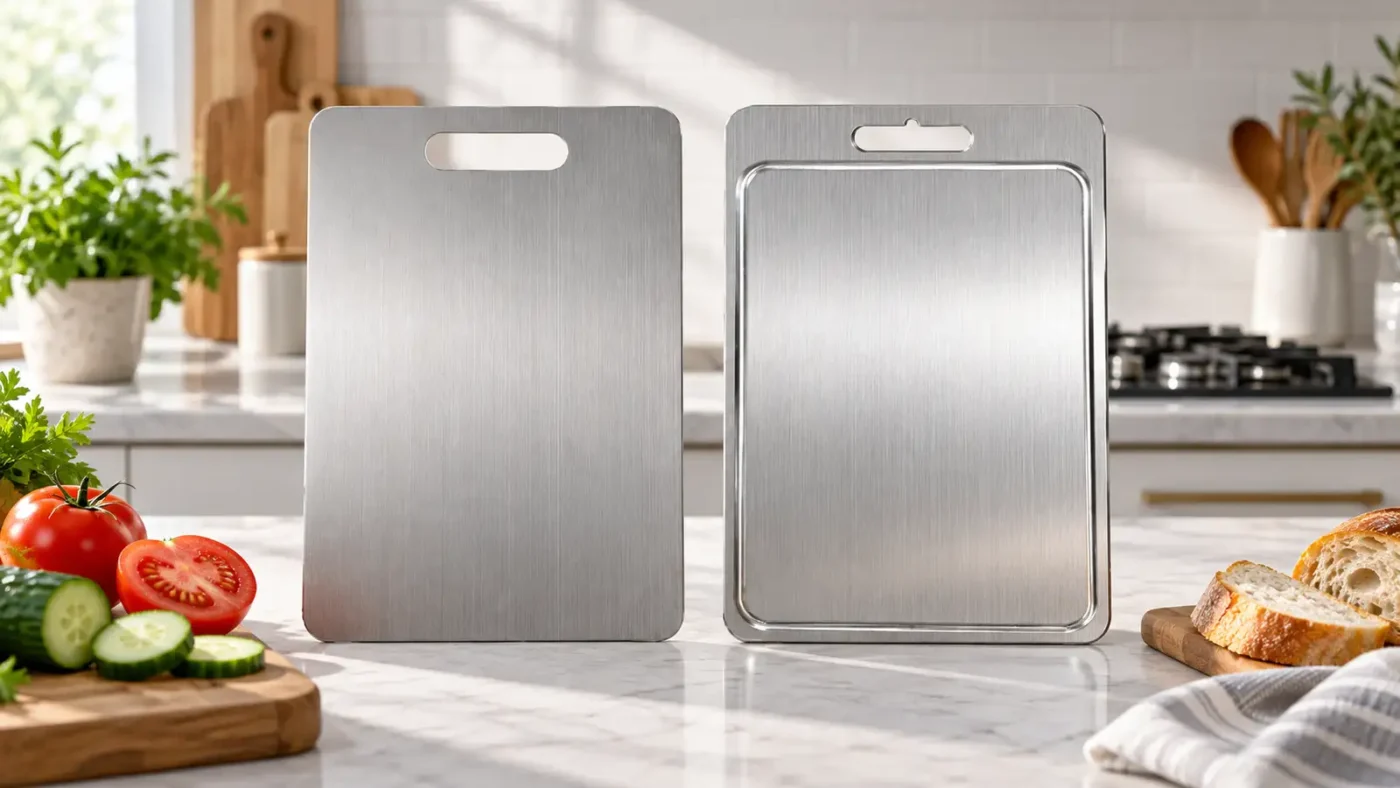
Choose titanium when a lower-density material, a thin storage profile, or a clearly specified pure titanium work surface matters enough to justify the price. Choose stainless steel when the finished board’s weight, construction, and cost fit your kitchen better. Both are metal cutting surfaces, so neither should be treated as automatically gentle on knife edges.
The material name is only the start of a useful titanium vs. stainless steel cutting board comparison. Size, thickness, total weight, support, finish, and care instructions can change how either board performs. Compare complete products of similar dimensions before deciding.
Titanium vs. Stainless Steel Cutting Boards at a Glance
| Buying question | Titanium cutting board | Stainless steel cutting board |
|---|---|---|
| How easy is it to move? | Titanium’s lower material density can help reduce weight when dimensions and construction are comparable; check the listed finished weight. | A comparable steel body may be heavier, but actual weight still depends on size, thickness, and added components. |
| Will it stay put? | Material alone does not determine stability. Check the complete base or support setup. | Greater finished weight may help some designs feel planted, but it does not prevent sliding by itself. |
| What about knives? | It is a metal cutting surface and can contribute to knife-edge wear. | It is also a metal cutting surface; do not assume it will preserve an edge like a suitable softer board. |
| How does it age? | Knife marks and visible finish changes can develop with use. | Scratches and finish changes can also occur; appearance depends on finish and use. |
| What maintenance is required? | No wood-style oiling or seasoning, but the exact board’s washing and drying instructions still apply. | Usually no wood-style oiling or seasoning; follow the alloy-, finish-, and component-specific care instructions. |
| What should you verify? | Whether “titanium” describes the complete board, a working surface, or a coating. | Steel type, construction, finish, dimensions, weight, and any attached feet or frame. |
This table describes decision points, not guaranteed outcomes for every product.
Which Board Is Easier to Lift, Wash, and Store?
Titanium may be easier to handle when you compare boards with similar geometry, but only the finished specifications can confirm the difference. Titanium has a lower material density than common stainless steels. If two boards had the same length, width, thickness, and basic construction, the titanium version could use less mass.
Real products rarely match in every dimension. A thin stainless steel board may weigh less than a thicker or larger titanium board. Rubber supports, frames, handles, and double-sided assemblies also affect the total. Do not use material density as a substitute for the listed product weight.
Think through the entire route the board takes. Confirm that you can lift it from storage, fit it on the counter, turn it inside the sink, dry it safely, and put it away without crowding the space.
If you have already decided on titanium and need help matching dimensions and features to your kitchen, use TiRoam’s titanium cutting board buying guide.
Does Stainless Steel Automatically Feel More Stable?
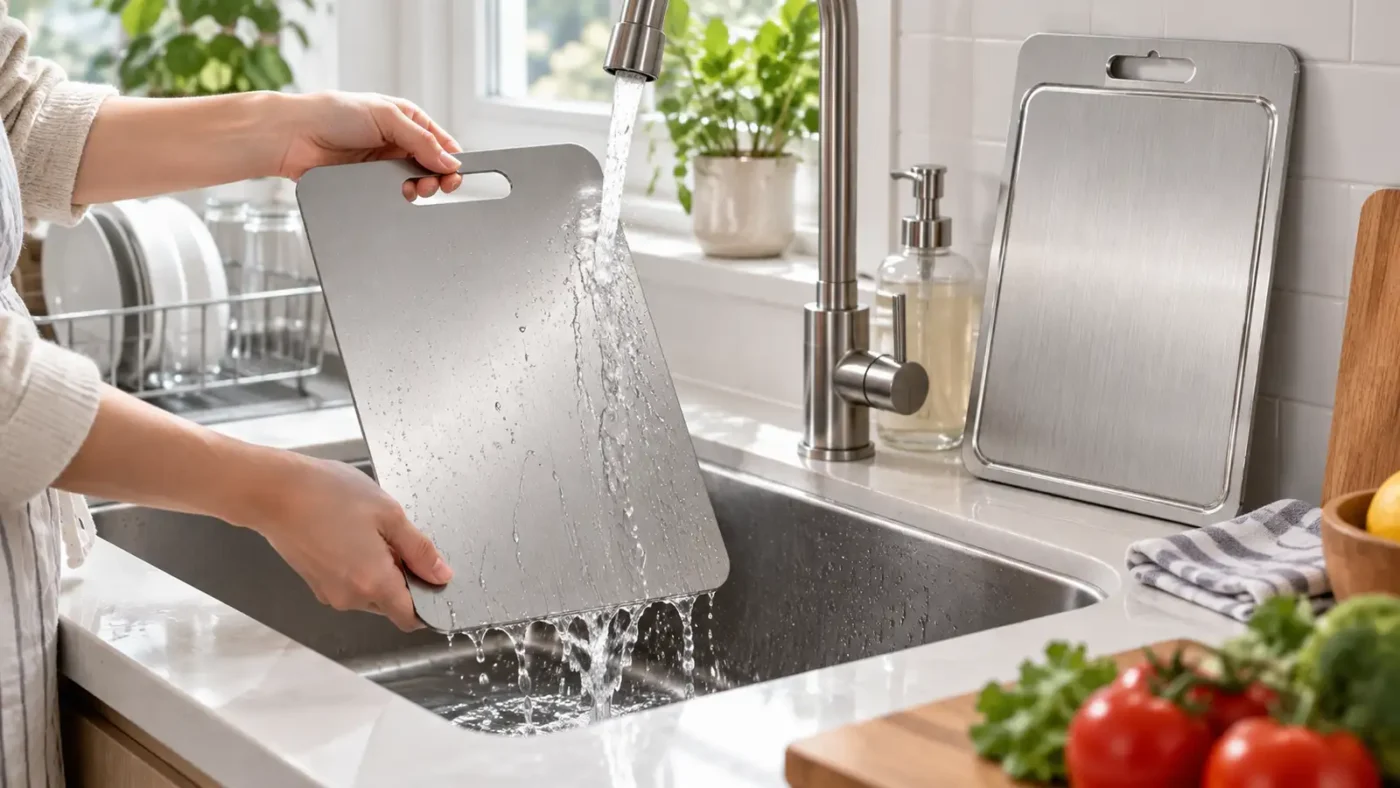
No. Weight can influence handling, but stability depends on the complete board, its support, and the counter beneath it. A heavier board may resist small movements in some setups, yet a smooth metal underside can still slide on a smooth or wet counter.
Check whether the product includes feet, a mat, a frame, or another intended support. Before cutting, confirm that the board sits flat and does not rock or move under normal pressure.
Keep two issues separate: the board moving on the counter and an ingredient moving on the board. A base support can address the first problem, but it does not automatically change the grip of the cutting surface.
Handles and grooves also affect use. A handle may make a board easier to carry to the sink. A perimeter groove can collect some liquid during juicy prep, but it reduces uninterrupted cutting area and adds another section to wash. These are design choices, not benefits guaranteed by titanium or stainless steel.
Which Material Is Better for Your Knives?
Neither metal should be assumed to be as forgiving as an appropriate softer cutting surface. Both bring a knife edge into repeated contact with metal. Knife steel, edge geometry, pressure, motion, and finish all affect wear.
Claims such as “will never dull knives” require a defined comparison using the actual boards and knives. A material label or a scratch on the board does not prove how well a knife retained its edge.
If preserving a thin or finely sharpened edge is your highest priority, you may prefer to keep a suitable wood or synthetic board for that knife. Different boards can serve different tasks; the choice does not have to be all-or-nothing.
TiRoam’s detailed article, Do Titanium Cutting Boards Dull Knives?, explains the evidence limits and practical knife-care trade-off without promising a fixed sharpening schedule.
How Will the Surface Change With Use?
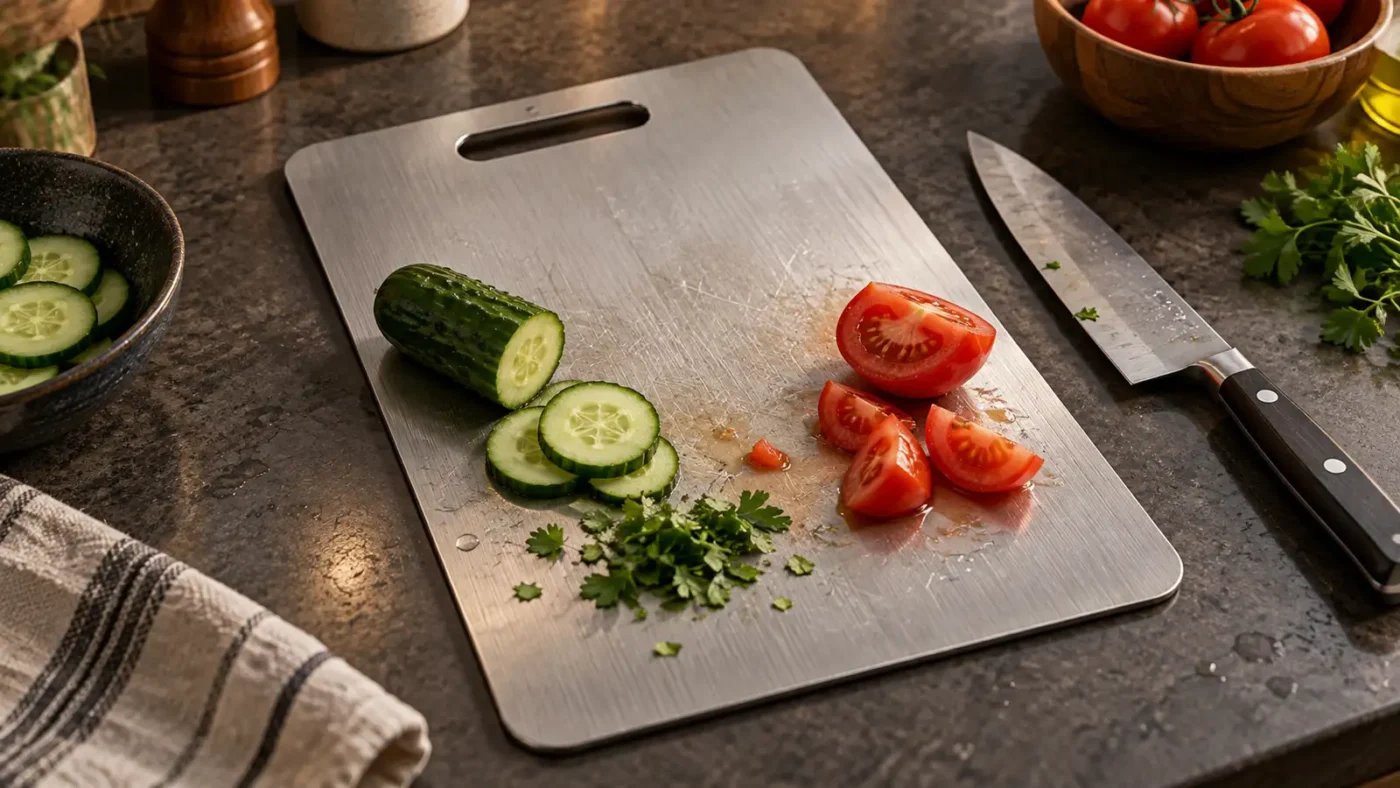
Expect a working metal surface to change in appearance. Cutting, gathering ingredients, washing, and drying can leave visible marks. Their prominence depends on the original finish, lighting, technique, pressure, and frequency of use.
Different brushed or polished finishes can show marks differently. Product photographs show the new finish; they cannot establish how a board will look after months of use.
Cosmetic marks and physical damage are not the same. Clean and dry the board before inspection. Pause use and contact the manufacturer if you find a sharp raised edge, crack, deep gouge, deformation, or unexplained instability. Do not sand or polish a food-prep board unless its manufacturer recommends that treatment for the exact model and finish.
For a fuller inspection process, read Knife Marks on Titanium Cutting Boards: What Changes With Use?.
Is Titanium or Stainless Steel Easier to Clean?
Both can avoid the periodic oiling associated with many wooden boards, but neither material name replaces product-specific care instructions. Check the finish, attached parts, dishwasher guidance, and cleaning tools allowed for the exact model.
For TiRoam’s Integrated-Handle Pure Titanium Cutting Board, the established routine is warm water, mild dish soap, and a soft sponge, followed by thorough rinsing and drying before storage. The groove and handle area need attention where present. Aggressive abrasives can change the brushed appearance.
A stainless steel board may have different instructions based on its alloy, finish, feet, frame, or adhesive components. Do not assume dishwasher compatibility simply because the working surface is metal.
Normal food-separation practices still apply. Wash after preparation, and use separate boards for raw and ready-to-eat ingredients where practical. TiRoam’s pure titanium kitchenware cleaning guide covers broader washing questions.
When Does a Titanium Cutting Board Make More Sense?
Titanium is worth considering when the complete board gives you a meaningful handling, storage, or material-specification advantage. It may fit your routine when:
- You want a clearly identified pure titanium cutting surface.
- A lower listed finished weight makes the size easier to move and wash.
- A thin board fits your available storage.
- You prefer a titanium model’s particular handle, flat surface, or groove layout.
- You accept the price and possible knife-maintenance trade-off.
TiRoam’s Flat Pure Titanium Cutting Board offers an uninterrupted brushed work surface and built-in handle in three listed sizes. Use its specifications to judge that product, not titanium boards as a whole. You can compare other verified designs in the TiRoam Titanium Cutting Boards collection.
For the broader question of whether this material fits your preparation habits, read Are Titanium Cutting Boards Good? Practical Pros and Cons.
When Does a Stainless Steel Cutting Board Make More Sense?
Stainless steel may be the practical choice when a specific board provides the size, stability setup, finish, and price you want. It may fit better when:
- The finished weight is manageable for your sink and storage route.
- The base or support design works on your counter.
- The usable cutting area fits your regular ingredients.
- The manufacturer clearly identifies the steel and construction.
- Its care instructions and expected surface changes fit your routine.
Do not choose it only because steel seems heavier, more familiar, or easier to clean. Verify those qualities on the actual product. Likewise, do not assume titanium is automatically superior because it costs more.
A Five-Step Buying Check
Compare two boards under the same checklist before buying.
- Verify construction. Identify the complete board, working surface, coating status, and attached components.
- Match dimensions. Compare overall size and usable cutting area, not just product photos.
- Check finished weight and support. Decide whether you can move it comfortably and keep it stable.
- Plan for knife and surface care. Accept that a metal work surface can affect edges and show marks.
- Review exact cleaning instructions. Include grooves, handles, feet, and drying requirements.
The better board is the one whose complete design fits your counter, sink, knives, storage, and preparation habits. In a stainless steel vs. titanium cutting board decision, the material matters—but the finished product determines what you will notice every day.