
Cookware & Food Prep
Are Titanium Cutting Boards Safe? What the Surface, Tests, and Daily Use Tell You
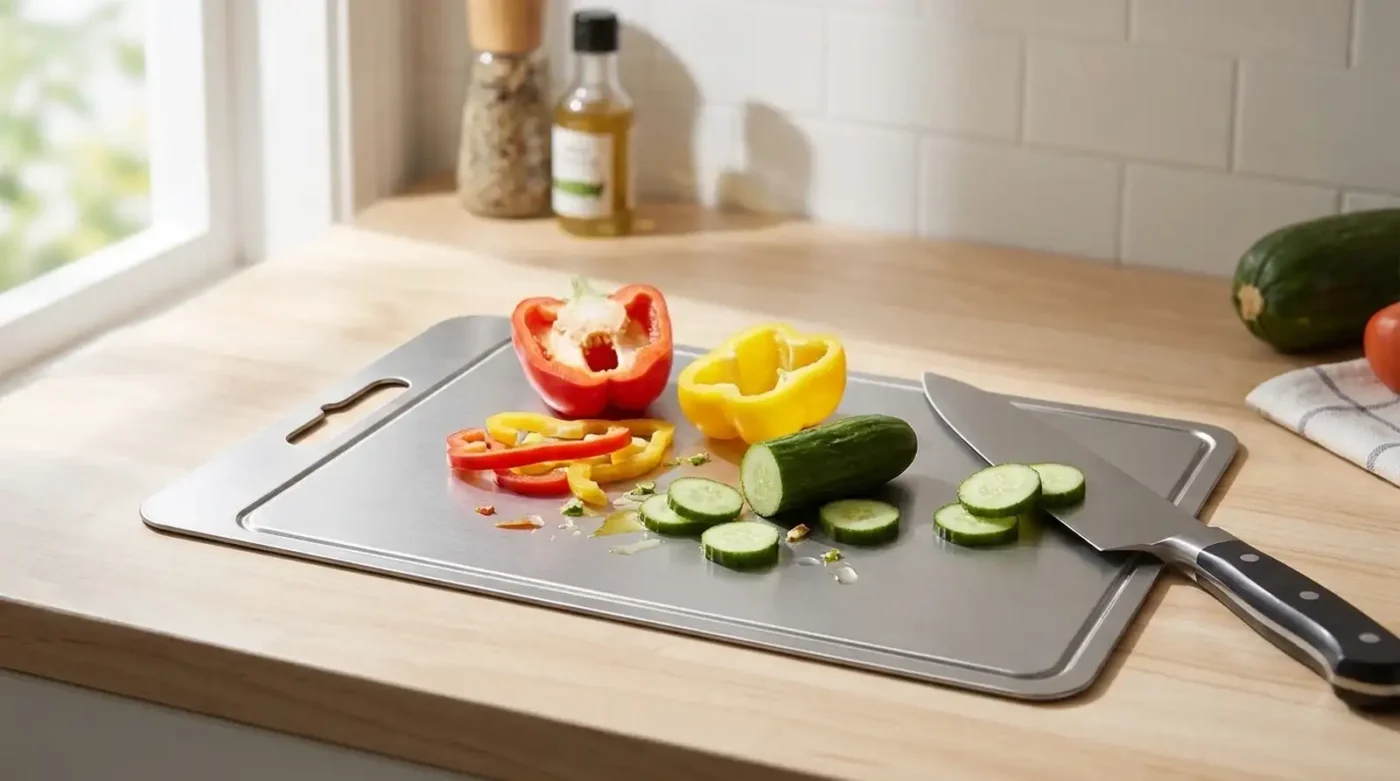
If you are thinking about switching from plastic or wood, the first question is usually simple: are titanium cutting boards safe? For a board made from solid commercially pure titanium, used and washed the way you would wash any cutting board, the short answer is yes for everyday home food prep. The details matter, though. “Titanium” on a listing can mean very different things, a test report only covers what was tested, and good kitchen hygiene still applies to every board material.
This guide walks through what actually touches your food, what food-contact testing can and cannot tell you, and how a titanium board fits into daily prep.
Are Titanium Cutting Boards Safe? The Short Answer
A titanium cutting board is a reasonable, safe choice for home kitchens when three things are true:
- The cutting surface is solid titanium, not a coating. Your knife and food touch the metal itself, not a layer that can wear away.
- The maker can show food-contact test results for the material or a sample board, and tells you which standards were used.
- You clean it like any other board. No cutting board material removes the need to wash after raw meat or to keep raw and ready-to-eat foods apart.
Titanium is widely used for food-contact gear because commercially pure grades are stable and corrosion-resistant in normal kitchen conditions. That does not make every product labeled “titanium” equal, so the rest of this guide is about telling the difference.
What Touches Your Food: Solid Titanium, Titanium-Coated, or Alloy
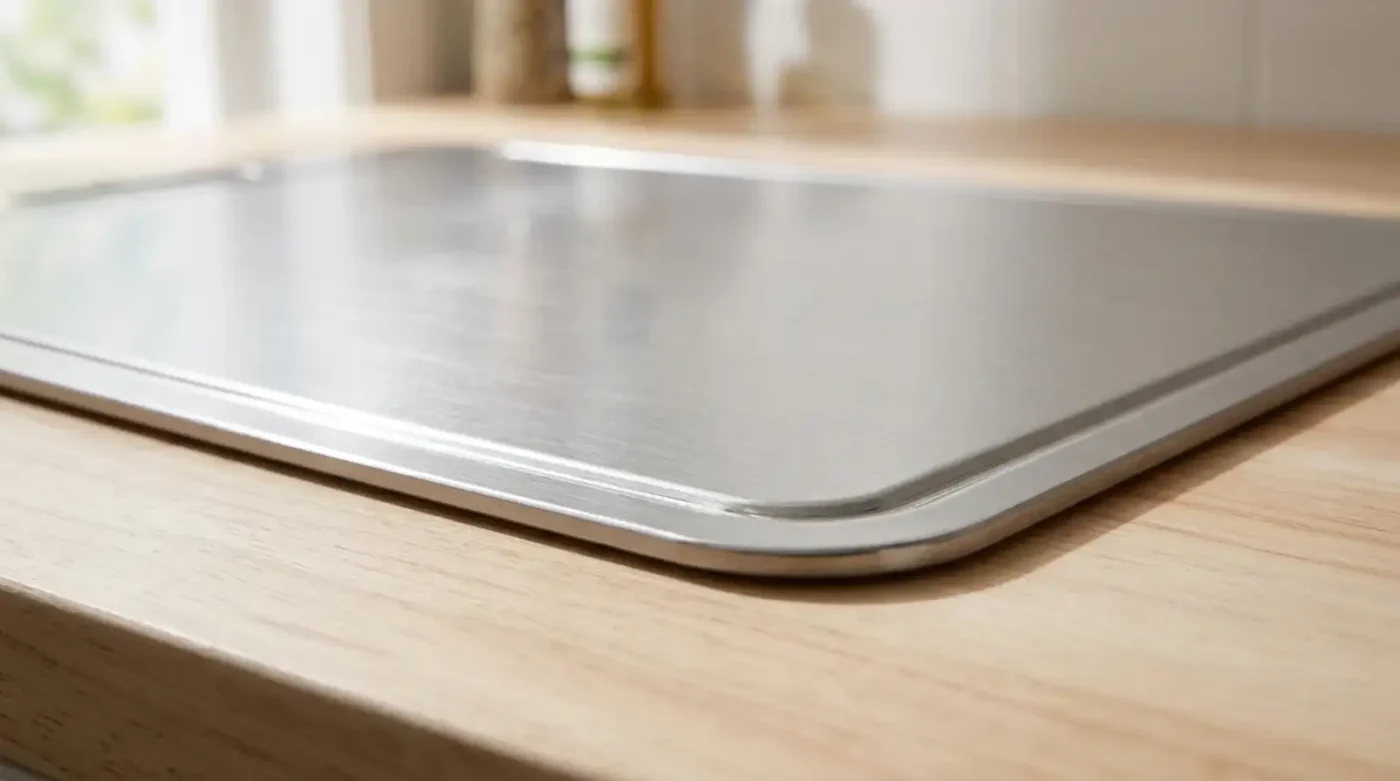
When people ask “is a titanium cutting board safe,” they are really asking about the surface that meets their food. Three very different products are sold under the same word:
- Solid commercially pure titanium. The board is a titanium sheet all the way through. Grades such as TA1 (commonly treated as equivalent to ASTM Grade 1) are mostly titanium with small, controlled amounts of other elements. There is no separate cutting layer to chip or peel.
- Titanium-coated boards. A thin titanium-based layer sits on top of another material, often stainless steel or plastic. The coating is what you cut on, so its durability under daily knife work is the real question. Our guide to pure titanium vs. titanium-coated kitchenware explains how to tell them apart.
- Titanium alloys. Alloys mix titanium with other metals for strength. They are not automatically unsafe, but you should know which alloy it is and whether it was tested for food contact.
TiRoam cutting boards are made from TA1 commercially pure titanium sheet. A third-party composition analysis of the sheet measured about 99.9% titanium (99.88%). There is no PFAS, PTFE, or PFOA coating; food is prepared directly on the titanium surface, with no plastic cutting layer or synthetic surface coating.
What Food-Contact Tests Show (and What “Pass” Does Not Mean)
A product page that just says “food safe” tells you very little. A useful claim names the standard, the lab, and what was tested. Here is what TiRoam’s cutting board testing covers:
- Extractable lead (U.S.). The TA1 sheet passed an extractable-lead test under U.S. 21 CFR 109.6 (SGS, 2025).
- EU and German food-contact checks. A sample board of the same design was tested by an independent lab under EU 1935/2004, German LFGB, and the Council of Europe resolution on metals and alloys in food-contact materials. The checks covered odour and taste, 24 extractable heavy metals, and overall migration, and all passed.
That is why our product pages say the boards are “tested to selected U.S. FDA-related and EU/LFGB food-contact requirements.” The word selected is deliberate. A pass result means:
- The tested material or sample met the limits of those specific tests, under the lab’s test conditions.
- It does not mean every possible substance was tested, and it is not an FDA “approval” of the product.
- It does not say anything about bacteria. Hygiene depends on how the board is cleaned and used.
If you want to read any brand’s test report with a critical eye, including ours, see how to read titanium cookware safety test reports.
Is a Titanium Cutting Board Hygienic for Raw Meat?
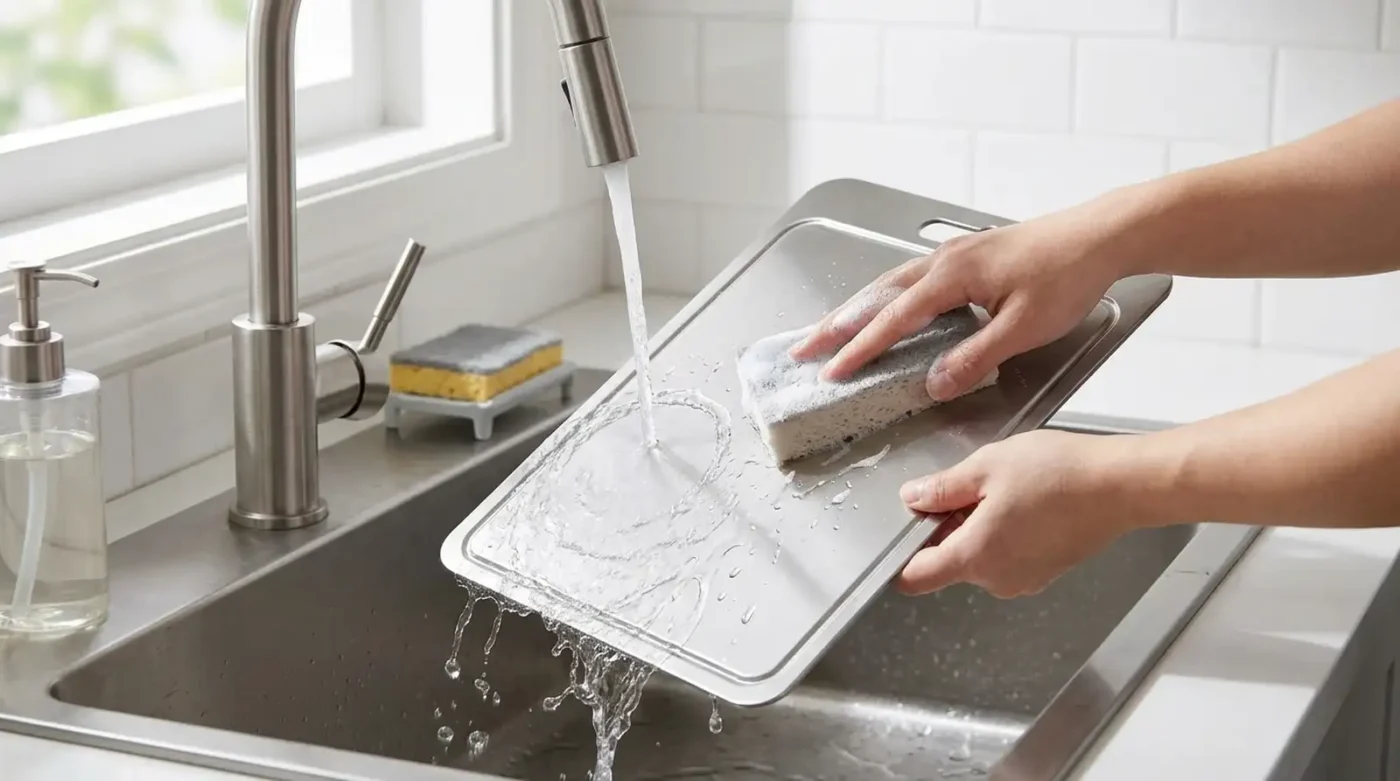
A titanium surface is nonporous. Unlike wood, it does not soak up meat juices, and unlike a well-used plastic board, it does not develop deep, fuzzy cuts that hold residue. That makes it straightforward to clean: hot, soapy water, a rinse, and a dry is usually all it needs.
Nonporous does not mean self-cleaning, though. No board material, titanium included, should be counted on to kill bacteria for you. For raw meat, poultry, and seafood:
- Wash the board with hot, soapy water right after use, before it touches anything else.
- Keep raw proteins and ready-to-eat foods such as salad, bread, or fruit on separate boards, or fully wash the board between them.
- Dry the board before storing it, especially if you stack it with other tools.
This matches USDA guidance on keeping raw meats separate: if possible, use one board for meat, poultry, and seafood and another for fruits and vegetables, and wash boards with hot, soapy water between foods.
For step-by-step routines, including what to do with stubborn residue, see how to clean pure titanium kitchenware.
Do Knife Marks Make a Titanium Board Less Safe?
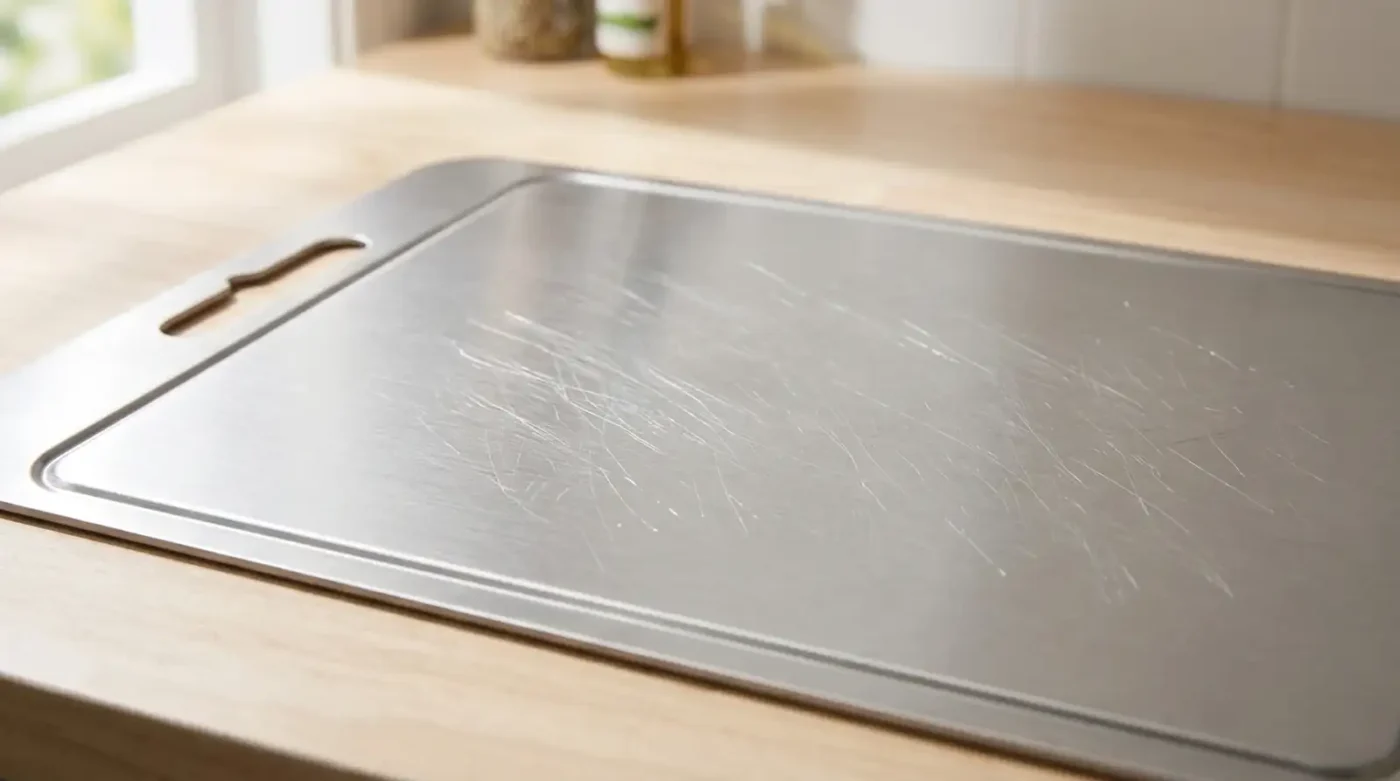
Titanium is softer than most knife steel but harder than wood or plastic, so a titanium board will show fine surface marks over time. These marks are shallow lines in solid metal. They do not expose a different material underneath, because there is no coating to cut through, and they do not turn into the fibrous grooves that make an old plastic board hard to clean.
What matters is that you keep washing those marks clean like the rest of the surface. If you want to know which marks are normal and how to keep the surface looking even, read our guide to titanium cutting board scratches.
A related question is what a metal board does to your knife edge. That is a separate trade-off from food safety, and we cover it honestly in do titanium cutting boards dull knives.
When Another Board May Suit You Better
Being safe does not mean being right for every kitchen. You may prefer a different board if:
- Edge life is your top priority. Wood and some plastics are gentler on fine knife edges.
- You do heavy cleaver work on bones. A thick wood block absorbs that kind of impact better than a thin sheet of any material.
- You want a quiet, soft cutting feel. Metal boards feel and sound different from wood.
Many cooks keep a titanium board for raw proteins and quick daily prep, and a wood board for long chopping sessions. If you are still comparing materials, our best cutting board material guide and titanium vs. stainless steel cutting board comparison go deeper.
A Quick Safety Checklist Before You Buy
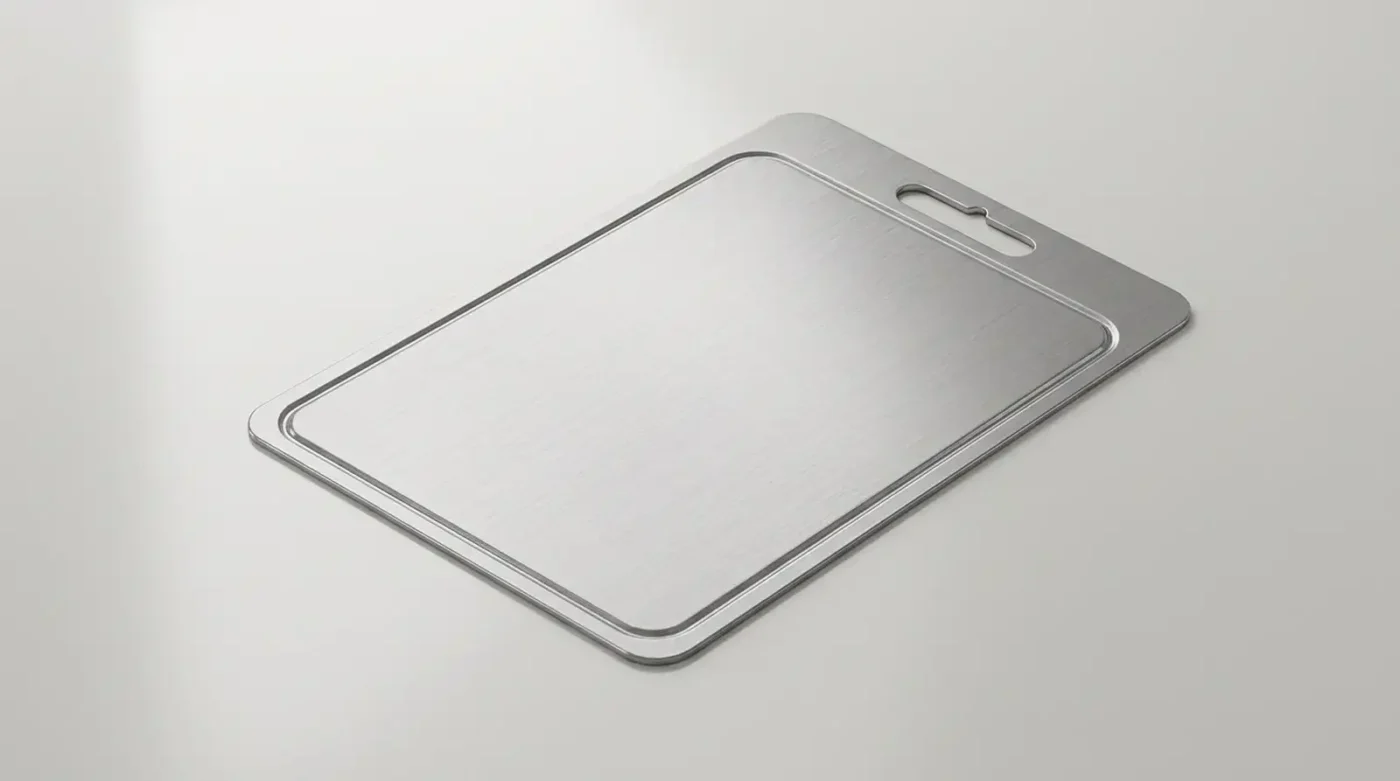
Before ordering any titanium cutting board, check:
- Material: Does the listing name the grade (for example, TA1 or Grade 1), or only say “titanium”?
- Construction: Is it solid titanium, or a titanium coating over another material?
- Testing: Does the brand name the standards, the lab, what was tested (sheet or finished board), and the year?
- Edges and finish: Are the edges smooth and the surface free of sharp burrs?
- Size and weight: Is it the right size for your counter and sink, and light enough to wash comfortably?
- Care instructions: Does the brand tell you clearly how to clean it?
For a full breakdown of sizes, surface textures, and handle styles, see our guide on how to choose a titanium cutting board, or compare TiRoam’s options, including the Long-Side Handle board, in our titanium cutting boards collection.
Titanium Cutting Board Safety FAQs
Are titanium cutting boards healthy?
A cutting board does not add health benefits to food. What a solid titanium board offers is a stable, nonporous surface with no plastic cutting layer and no synthetic coating, which some cooks prefer for daily prep.
Are titanium cutting boards safe to use with raw meat?
Yes, as long as you wash the board with hot, soapy water after use and keep raw proteins away from ready-to-eat foods, the same rules that apply to any board.
Is titanium safe for a cutting board if it gets scratched?
On a solid titanium board, scratches are marks in the same metal, not a damaged coating. Keep them clean like the rest of the surface.